The Historical Context and Haussmann’s Paris
To truly understand Camille Pissarro’s Boulevard Montmartre series, we must first look at the radical physical transformation of Paris itself. During the mid-19th century, under the direction of Napoleon III, Georges-Eugène Haussmann led a massive urban renewal project that completely redesigned the French capital. The narrow, winding, and disease-prone medieval streets were systematically demolished and replaced by broad, straight avenues lined with uniform, neoclassical buildings. This architectural revolution provided Impressionist painters with a brand-new, modern landscape to capture, characterized by sweeping vistas and bustling public spaces.
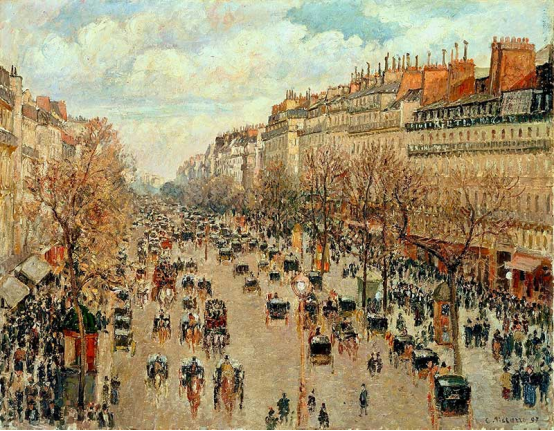
Pissarro painted this magnificent series in 1897 from the window of his room at the Grand Hôtel de Russie. Suffering from a recurring eye infection that strictly prevented him from painting outdoors in the elements, he ingeniously turned his hotel window into his primary studio. This elevated vantage point offered a sweeping, uninterrupted view of the grand boulevard, allowing him to observe the relentless, chaotic flow of modern urban life from a safe, detached, and highly analytical distance.
Mastering Light and Atmospheric Conditions
Impressionism is fundamentally about capturing the fleeting, ephemeral effects of light, and the Boulevard Montmartre series stands as a masterclass in this specific discipline. Pissarro did not just paint a static street; he painted the air, the weather, and the precise time of day. By creating over a dozen variations of the exact same composition, he meticulously documented how radical shifts in sunlight, cloud cover, and seasonal weather completely alter the visual and emotional resonance of an urban scene.
The Science of Impressionist Color Palettes
Rather than relying on stark, flat blacks to render shadows, Pissarro employed complex mixtures of deep blues, rich purples, and cool grays to represent the absence of direct light. When depicting a sunny winter morning, his rapid brushstrokes captured the crisp, golden reflection of the sun bouncing off the carriage roofs and the pale stone facades of the buildings. In sharp contrast, his rainy day depictions utilize muted silvers, soft grays, and wet, highly reflective brushwork that makes the cobblestones appear slick, shimmering, and deeply atmospheric.
The Trajectory of Movement and Urban Life
Beyond the masterful application of light, the sheer kinetic energy of Boulevard Montmartre is driven by its rigorous linear trajectory. Pissarro utilized strict one-point perspective, a classical technique that he modernized to draw the viewer’s eye forcefully down the receding avenue until it vanishes seamlessly into the hazy, atmospheric Parisian background.
Guiding the Viewer’s Eye Through Space
The converging lines of the uniform buildings, the rhythmic rows of newly planted trees, and the endless, flowing stream of horse-drawn carriages all serve as powerful visual vectors. These vectors create an intense sense of spatial depth and forward motion. The carriages and pedestrians in the immediate foreground are painted with distinct, textured, and heavy dabs of paint (impasto), while those further down the boulevard dissolve into abstract, blurred specks of color. This technique perfectly mimics the natural depth of field of the human eye, forcing the viewer to actively participate in the act of seeing.
Comparative Analysis: Time and Weather in the Series
To fully appreciate the depth of Pissarro’s artistic vision, we must compare the distinct variations within the overarching Boulevard Montmartre series. Below is a detailed breakdown of how different environmental conditions dictated his specific artistic choices and color palettes.
| Painting Variation | Lighting and Atmosphere | Emotional Tone |
|---|---|---|
| Winter Morning | Crisp golden light, long sharp shadows, pale blue skies. | Energetic, optimistic, and bustling with early day activity. |
| Night Effect | Artificial gas lamps, glowing storefronts, dark violet skies. | Mysterious, highly modern, and deeply atmospheric. |
| Spring Rain | Diffused gray light, reflective wet pavement, muted tones. | Melancholic, subdued, and beautifully introspective. |
Expert Advice: How to Analyze Impressionist Masterpieces
When studying complex works by masters like Pissarro, Monet, or Renoir, standard classical art analysis often falls short. Here is a technical checklist designed to elevate your art appreciation skills and help you see the canvas like a true historian:
- Step Back for Optical Blending: Impressionist paintings are explicitly meant to be viewed from a distance. Up close, the broken brushstrokes seem chaotic and disjointed; from afar, your eye performs “optical blending” to create a cohesive, vibrant, and luminous image.
- Analyze the Shadows: Look closely for the total absence of black pigment. Notice how complementary colors (like blue and orange, or purple and yellow) are placed side-by-side to create profound depth and vibration in shaded areas.
- Trace the Light Source: Determine the exact time of day by examining the angle, length, and color temperature of the cast shadows on the ground and buildings.
- Observe the Edge Quality: Notice how edges are intentionally softened or blurred to convey rapid movement, especially in dense crowds or fast-moving carriages.
Frequently Asked Questions (FAQ)
- Why did Pissarro paint the Boulevard Montmartre so many times?
- Pissarro painted the series to systematically explore how changing light, shifting weather patterns, and the progression of seasons altered the exact same urban landscape. This serial approach was a defining hallmark of mature Impressionism, allowing the artist to capture the ephemeral, fleeting nature of time itself.
- Where exactly was Pissarro positioned when he painted this series?
- He painted the entire series from the elevated vantage point of his rented room at the Grand Hôtel de Russie in Paris. A severe eye infection prevented him from working outdoors in the wind and dust, thus turning the hotel window into his primary observation deck.
- What specific role does trajectory play in this painting?
- Trajectory, firmly established through strict one-point linear perspective, forcefully draws the viewer’s eye down the center of the avenue. It creates a highly dynamic sense of motion and three-dimensional depth, perfectly reflecting the fast-paced, modern energy of late 19th-century Paris.
- How does Pissarro’s urban landscape differ from his earlier rural scenes?
- While his earlier rural scenes focus heavily on agrarian life, peasant labor, and natural tranquility, his later urban landscapes emphasize strict architectural geometry, the chaotic, anonymous movement of city crowds, and the modern infrastructure brought about by Haussmann’s renovation of Paris.