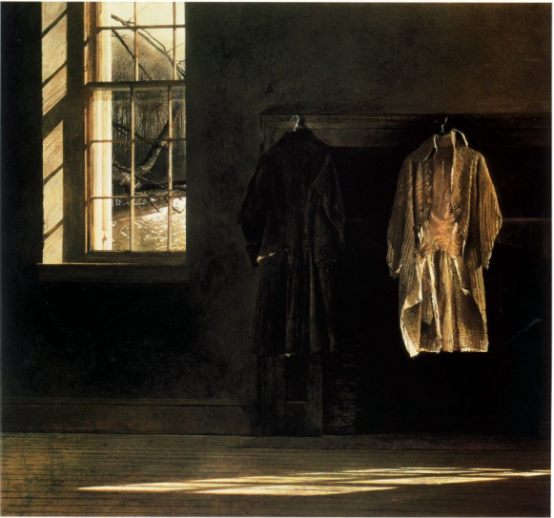
In the constellation of American art, Andrew Wyeth holds a uniquely captivating star. Retreating from the hustle and bustle of the city and eschewing the intensity of abstraction, his work focuses on capturing with delicate brushstrokes the wildness of rural Pennsylvania, the tranquil snowscapes of the Maine coast, and even the fine lines carved by time on ordinary faces. Wyeth’s paintings lack dazzling chromatic amalgamations or grand narrative scenes, yet they possess a penetrating power: a deserted field, a time-worn farmhouse, a figure bowed in deep thought—each one resonates deeply within the viewer. Wyeth depicts a “quiet world” where the bleak beauty of nature coexists with the loneliness and longing of the human heart. Anyone who encounters his paintings will find fragments of their own memories and time on these canvases.
1. Artistic atmosphere: draw inspiration from details
Andrew Wyeth was born in 1917 into an artistic family in Chadds Ford, Pennsylvania. His father, N.C. Wyeth, was a famous illustrator who illustrated classics such as Robin Hood and The Legend of King Arthur, while his mother, Carolyn Wyeth, also had a solid artistic background. For Wyeth, art was not a skill acquired later in life, but a language that was integrated into life from an early age – his childhood was filled with close contact with art. In his father’s studio, he often surrounded his father, watching him use a fine brush to outline the details of the knight’s armor and use paint to blend the layered colors of the forest. Wyeth’s father never forced him to learn to paint, but taught him subtly through observation and his love of details: “Look at that dead leaf, its edges are not regular, and each crack records the story of the wind.”
This profound sensitivity to detail became a core element of Wyeth’s art. At 15, a heart attack prevented him from completing his studies, and his father became his full-time art mentor, teaching him composition, perspective, and color theory. The most important lesson was how to “penetrate the surface and discern the essence.” Wyeth’s father often emphasized that when painting an apple, one must not only depict its color and shape, but also capture the subtle blemishes on the sunlit skin and the withered stem. These seemingly insignificant details symbolize the apple’s true life.
2. Portraits: Narrating the true meaning of life through silence
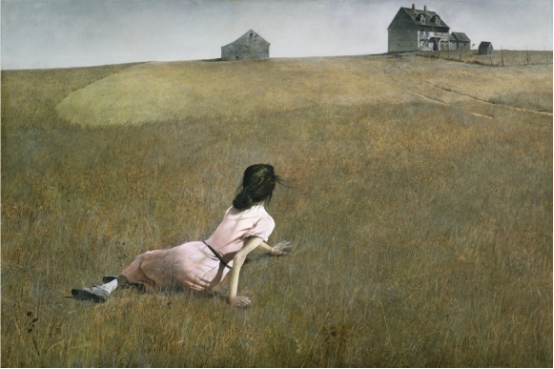
Wyeth’s work always revolves around people, yet his paintings are not fleeting “perfect portraits,” but rather unspoken emotions. One of his most representative works is the series inspired by his neighbor, Christina Olson, with Christina’s World, in particular, becoming a classic of American art.
In 1948, Wyeth first met Christina, a woman who had lost the ability to walk due to polio. She often crawled through the fields on her hands, longing to return home. Moved by her resilience, Wyeth spent months observing Christina’s life: tending the flowers on her windowsill in the morning sun, sitting on the porch, gazing into the distance, and recounting past memories. Ultimately, these meticulous observations converged into “Christina’s World.” In the painting, Christina, dressed in a light-colored dress, lies sprawled across a vast field, gazing at a small farmhouse that almost blends into the horizon. Wyeth avoids depicting Christina’s expression, instead conveying a powerful sense of longing and persistence through her tense body and outstretched hands.
The painting’s appeal lies in its “white space.” Wyeth doesn’t deliberately express her emotions, but through her poses and body language, she conveys her inner longing and loneliness. Wyeth once said, “What I want to express is that each of us has a distant destination in our hearts, and no matter how hard we try, the road ahead is always long and full of challenges.”
3. Landscape Description: Seeing the Poetry of Time in Desolation
Wyeth was not only passionate about figure painting, he was also deeply fond of the rural landscapes of Pennsylvania and Maine. His works never focused on depicting those “idealized pastoral scenes”, but instead focused on those “desolate corners” carved by time – dilapidated farmhouses, tilted fences, and snow-covered fields. These scenes in Wyeth’s paintings often give people a poetic beauty.
In “Winter 1946,” Wyeth depicts an isolated red farmhouse blanketed in snow, a tranquil expanse stretching to the horizon. The scene appears frozen in time. Wyeth employed the dry brush technique, a technique in which a nearly dry brush is swept across the canvas, creating a natural, textured effect. This “white silence” in Wyeth’s work conveys his feelings of loneliness and longing following his father’s death.
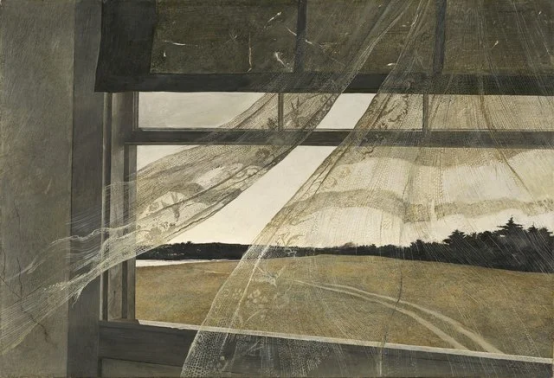
Another landscape, “Wind from the Sea,” cleverly depicts the relationship between nature and humanity through an open window and flowing curtains. Rather than depicting the entire coastline, Wyeth uses these windswept details to convey the presence of the sea breeze. Through these subtle hints, the viewer seems to sense the breath of the sea and the chill of the wind.
IV. Artistic Techniques: Time in Tempera and Drybrush
While his style is often categorized as realist, the emotions in his work often possess a certain abstract quality. He favored two distinct techniques—tempera and drybrush—that imbued his work with a tactile and emotional depth.
Tempera is an ancient technique that involves applying a mixture of pigment and egg yolk to a specially prepared gesso canvas. Although this technique demands skill, requiring the artist to complete the painting before the paint quickly dries, Wyeth believed this limitation allowed him to capture the “texture of time.” In Christina’s World, Wyeth uses tempera to depict each blade of grass in the field, each with a slightly different color variation, from yellow to green to a subtle brown. This subtle shift imbues the scene with a vivid and layered quality.
In his drybrush technique, Wyeth used a stiff brush to apply minimal amounts of paint, lightly brushing across the canvas, leaving a discontinuous trail of paint. This technique was often used to depict rough surfaces, such as the snow in Winter 1946 or the weathered wooden windows in Wind on the Seashore. This texture effectively conveys the “traces of time,” as if we can physically feel the passage of time within the painting.
5. Eternal Charm: Emotions Resonating Through Time
Although controversial for its melancholic atmosphere and nostalgic sentiments, Wyeth’s paintings, regardless of their audiences’ opinions, remain timeless and resonate deeply with people of all generations. In today’s fast-paced, bustling world, Wyeth’s works offer a breathing space—a place to pause and reflect on our inner selves. Whether it’s the loneliness and longing in “Christina’s World” or the nostalgia and yearning in “Winter 1946,” Wyeth’s paintings touch upon deeply shared emotions: loneliness, longing, and the relentless passage of time.
Wyeth’s art teaches us that great works of art often move us not through grand narratives or dazzling techniques, but through keen observation of detail, capturing those seemingly insignificant yet deeply emotional moments. Through the blades of grass, windows, and figures he depicts, we can rediscover inner peace and resonance in a bustling world.