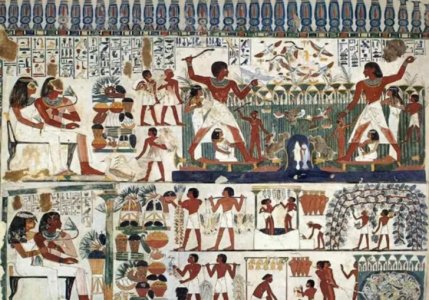
When I was sorting out materials last week, a group of pictures of ancient Egyptian murals from the tombs in the Valley of the Kings made me stop scrolling my mouse.
The “Perspective Code” in the Mural
The figures in ancient Egyptian murals are often considered to be “flat”, but a closer look reveals a hidden secret. In the murals of the tombs of nobles in Thebes, the heads of the figures are usually presented in profile, but the eyes are from the front, the torsos are from the front, and the legs are back to the side – this peculiar composition method is called the “frontal law”.
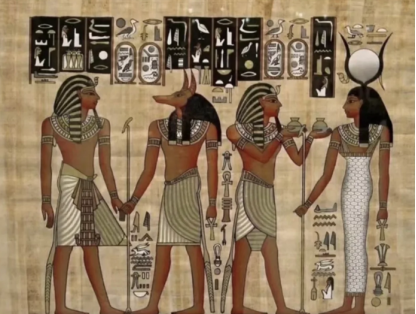
What is the “positive law”?
The Frontality Law is the core principle of ancient Egyptian art, which requires that characters be presented from a composite perspective: Head: frontal profile, highlighting the bridge of the nose and facial contours; Eyes: frontal perspective, looking straight ahead, symbolizing communication with gods or viewers; Shoulders and upper body: frontal display, embodying majesty and balance; Below the waist: return to the frontal profile, emphasizing the dynamics of the legs.
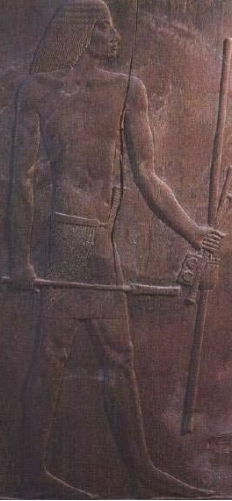
This rule is not only used in paintings, but also in sculptures and reliefs. For example, in the “Portrait of Heyard”, the profile of the character, the straight eyes and the straight shoulders form a contradictory yet harmonious unity, which not only retains the individual characteristics but also strengthens the sense of sacredness.
The Egyptians believed that if the life of the deceased was depicted on the tomb wall, life would not be cut off; if all the necessities of life were depicted on the tomb wall, support after death would be guaranteed.
Therefore, we can see autobiographical paintings of pharaohs and nobles on the walls of tombs. In many ministers’ tombs, they are clearly depicted inspecting their own territories, supervising farming, and their private large-scale handicraft workshops.
Moreover, many dignitaries and wealthy people believed that the great wealth they possessed during their lifetime would be transferred to the afterlife through the depiction of plastic arts, magical scriptures and spells. For example, the tomb of the chief priest of the Fourth Dynasty was painted with a large number of his livestock, which were counted as follows: 1,055 large animals with horns, 3,029 small animals with horns, and 760 donkeys.

Ancient Egyptian murals are not only masterpieces of art, but also an important window into ancient Egyptian society and culture. Through these murals, we can get a glimpse of the ancient Egyptians’ lifestyle, religious beliefs and aesthetic concepts. They are a unique and rich part of ancient Egyptian civilization and have a profound impact on the art of later generations.