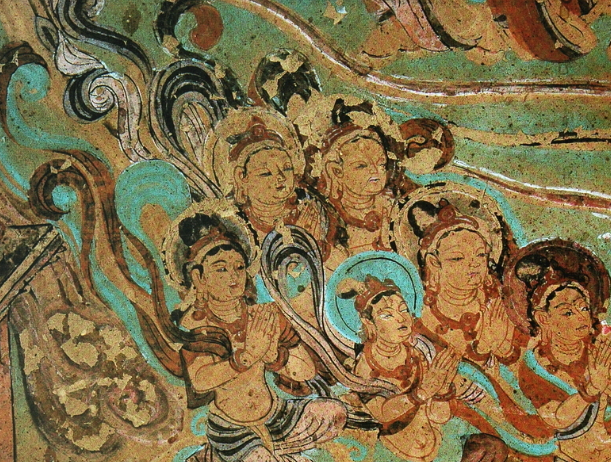
Note: The following article is intended to provide a resource for those who are interested in learning more about Dunhuang murals. If you know of any good online examples of formal analysis of Dunhuang murals, please leave a link in the comments below!
Ancient painters created the Pure Land in Dunhuang murals based on Buddhist classics and their own artistic imagination. The content of these murals is derived from real life, but it transcends reality and presents the Western Pure Land in people’s minds.
color
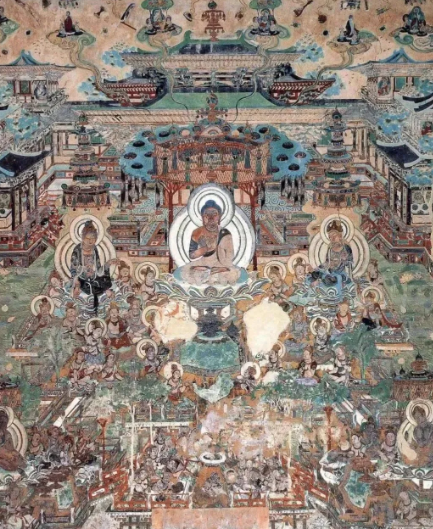
The color system of Dunhuang murals is extremely unique and rich. On the whole, the use of colors not only follows the traditional Chinese concept of five colors, but also develops a unique style in the context of Buddhist art.
In the early Dunhuang murals, such as the Northern Liang and Northern Wei dynasties, the colors were relatively simple, mainly natural colors such as earth red, malachite green, and earth yellow. These colors are derived from local mineral pigments. They are not only easy to obtain, but also have good stability. They can still retain their unique charm after thousands of years. For example, in some caves, earth red is used as a background color to create a warm and solemn atmosphere, setting the tone for the development of Buddhist stories. Malachite is often used to depict the sky, mountains and rivers of the Buddhist world, giving people a sense of freshness and tranquility, as if bringing people into an extraordinary fairyland.
As time went by, in the Tang Dynasty, the colors of Dunhuang murals reached their peak of splendor. At this time, the types of colors were richer, and the tones were brighter and more vivid. The extensive use of vermilion, gold and other colors symbolized the solemnity and sacredness of Buddhism. In murals depicting themes such as the Western Pure Land Transformation, vermilion was used to depict the clothing of Buddha and Bodhisattva, making them appear gorgeous and noble; gold was used to depict the decorations of palaces and pavilions, showing the magnificence of the Buddhist world. The use of this color is not only to pursue visual beauty, but more importantly, to convey the teachings and spiritual connotations of Buddhism through the symbolic meaning of color.
line
Lines play a vital role in Dunhuang murals, and are an important means of shaping images and expressing emotions. The lines of Dunhuang murals are diverse in style, with different characteristics in different periods.
The lines in early murals are mainly rough and simple. Painters use concise and powerful lines to outline the general outlines of people and animals. Although the lines are relatively simple, they are full of vitality and dynamics.
During the Northern Wei Dynasty, lines began to become more delicate, smooth, and rhythmic. When sketching figures, painters paid more attention to the expressiveness of lines, and expressed the skin texture, clothing texture, and movement posture of the figures through the changes in the weight, speed, reality, and virtuality of the lines. For example, in some images of flying celestial beings, smooth lines outline the flowing clothes and light postures of the flying celestial beings, as if people can see their dynamics of flying freely in the sky, giving people a sense of agility and beauty. This change in line style reflects the continuous improvement of painting skills and changes in aesthetic concepts at that time.
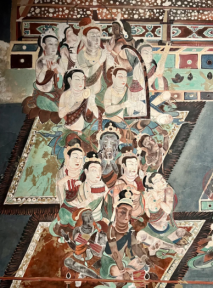
The Tang Dynasty was the mature period of Dunhuang mural line art, and the lines reached a superb level. The lines at this time could not only accurately express the shape and texture of objects, but also convey rich emotions and artistic conception. When depicting human figures, the lines were delicate and subtle, and could vividly express the facial expressions, eyes, and delicate texture of the skin.
Showing the charm of Buddhist art
The charm of Dunhuang murals is largely due to the perfect interweaving of colors and lines. Colors give the murals emotions and atmosphere, while lines give them images and vitality. The two are interdependent and complementary, and together they construct a colorful and vivid world of Buddhist art.