The Global Tapestry of Ancient Sculptural Discoveries
The unearthing of ancient sculptures provides an unparalleled window into the religious beliefs, political structures, and artistic sophistication of past civilizations. From accidental discoveries in rural farmlands to meticulous excavations in dense jungles, archaeologists continually piece together the fragmented history of human expression. These statues are rarely just decorative; they serve as vessels of divine power, testaments to royal authority, and sometimes, victims of political erasure.
By analyzing the material composition, stylistic nuances, and geographical placement of these artifacts, researchers can reconstruct ancient trade routes, cultural exchanges, and the evolution of artistic techniques. The sheer diversity of these discoveries—spanning the sands of Egypt, the highlands of Mesoamerica, the coasts of the Mediterranean, and the valleys of Asia—highlights a universal human drive to immortalize the ephemeral through stone, wood, and clay.
The Intersection of Art and Archaeology
Modern archaeological synthesis requires a multi-disciplinary approach. When a new sculpture is discovered, it is not merely cataloged and displayed. It undergoes rigorous scientific analysis, including radiocarbon dating, stratigraphy, and 3D photogrammetry. This comprehensive methodology ensures that every microscopic trace of pigment, every chisel mark, and every contextual clue is preserved and interpreted with the highest degree of accuracy.
- Contextual Stratigraphy: Understanding the exact soil layer where a statue is found helps determine its precise age and the environmental conditions of its era.
- Iconographic Analysis: Decoding the symbols, clothing, and posture of a figure to identify deities, historical figures, or mythological creatures.
- Material Sourcing: Tracing the origin of the stone or wood used in the sculpture to map ancient trade networks and resource management.
These analytical frameworks form the bedrock of modern antiquities research, allowing us to deeply investigate specific regional discoveries with a highly informed perspective.

Mesoamerican Masterpieces: Deities, Warriors, and Atlanteans
The dense jungles and ancient urban centers of Mesoamerica have recently yielded some of the most spectacular sculptural finds in modern history. The Maya and Toltec civilizations, known for their monumental architecture and complex cosmology, left behind a rich legacy of stone carvings that continue to baffle and inspire researchers. These artifacts are intimately connected to their complex calendar systems, agricultural cycles, and martial traditions.
Excavations at iconic sites like Chichen Itza and Palenque have revealed a stunning array of anthropomorphic and divine representations. These discoveries not only showcase exceptional artistic skill but also provide critical insights into the socio-political dynamics of the Late Classic and Postclassic periods in Mesoamerican history.
The 1,300-Year-Old Maize God of Palenque
In the ancient Maya city of Palenque, located in the modern Mexican state of Chiapas, archaeologists made a groundbreaking discovery: a perfectly preserved stucco head of the Maya Corn God (Hun Hunahpu). Dating back over 1,300 years, this artifact was found within a simulated watery underworld environment, specifically placed in a pond-like structure. The deliberate placement reflects the Maya belief system where the Maize God is decapitated in the underworld, only to be reborn, symbolizing the agricultural cycle of planting and harvesting.
The sculpture exhibits classic Maya aesthetic ideals, including the artificially elongated cranium and intricate facial scarification. The orientation of the head, facing east towards the rising sun, further emphasizes the themes of rebirth and cosmic renewal. This find underscores the profound connection between Maya agricultural practices and their mythological narratives.
Chichen Itza’s Atlantean Figures and Warrior Heads
Further north, the sprawling complex of Chichen Itza has offered up exceptional examples of martial and architectural sculpture. A recently unearthed Maya warrior head sculpture presents a vivid depiction of ancient military elite. Carved from limestone, the head features a prominent feathered helmet, likely representing an eagle or a serpent, denoting high rank and perhaps affiliation with specific warrior cults.
Equally significant is the discovery of an Atlantean sculpture at the same archaeological site. Standing approximately 90 centimeters tall, this figure features raised arms, designed to physically support an altar or a throne. The presence of Atlantean figures at Chichen Itza is a crucial indicator of intense cultural exchange—or direct political influence—from the Toltec civilization of central Mexico. These figures typically wear elaborate chest plates and segmented ear flares, blending Maya and Toltec iconographic traditions into a unique hybrid style.
- Architectural Functionality: Atlantean figures were not standalone art pieces; they were structural load-bearing columns that integrated art with engineering.
- Toltec Influence: The stylistic similarities between Chichen Itza’s sculptures and those found in Tula (the Toltec capital) provide hard evidence of vast Mesoamerican trade and ideological networks.
- Martial Symbolism: The warrior head’s feathered headdress indicates the utilization of exotic bird feathers, pointing to extensive tribute systems.
Complementing these finds are the decorative reliefs of El Cerron in El Salvador. Preserved beneath layers of volcanic ash, these intricate carvings offer a rare glimpse into the peripheral artistic expressions of Mesoamerica, demonstrating that sophisticated sculptural traditions extended far beyond the primary Maya heartlands.

Egyptian Enigmas: The Erased Legacy of Pharaoh Hatshepsut
Ancient Egyptian monumental sculpture was intrinsically linked to the concept of eternal life and divine kingship. Statues were believed to house the *ka* (spirit) of the deceased, ensuring their survival in the afterlife. However, this profound spiritual significance also meant that destroying a statue was tantamount to erasing a person’s existence from eternity. No historical case exemplifies this practice—known as *damnatio memoriae*—better than the fate of the female Pharaoh Hatshepsut.
Hatshepsut was one of Egypt’s most successful pharaohs, overseeing a period of immense wealth and prolific building programs during the 18th Dynasty. She commissioned hundreds of statues depicting herself in traditional male pharaonic regalia, including the nemes headdress and the false beard, to legitimize her unprecedented rule. Yet, decades after her death, a systematic campaign was launched to obliterate her legacy.
The Systematic Destruction and Modern Reconstruction
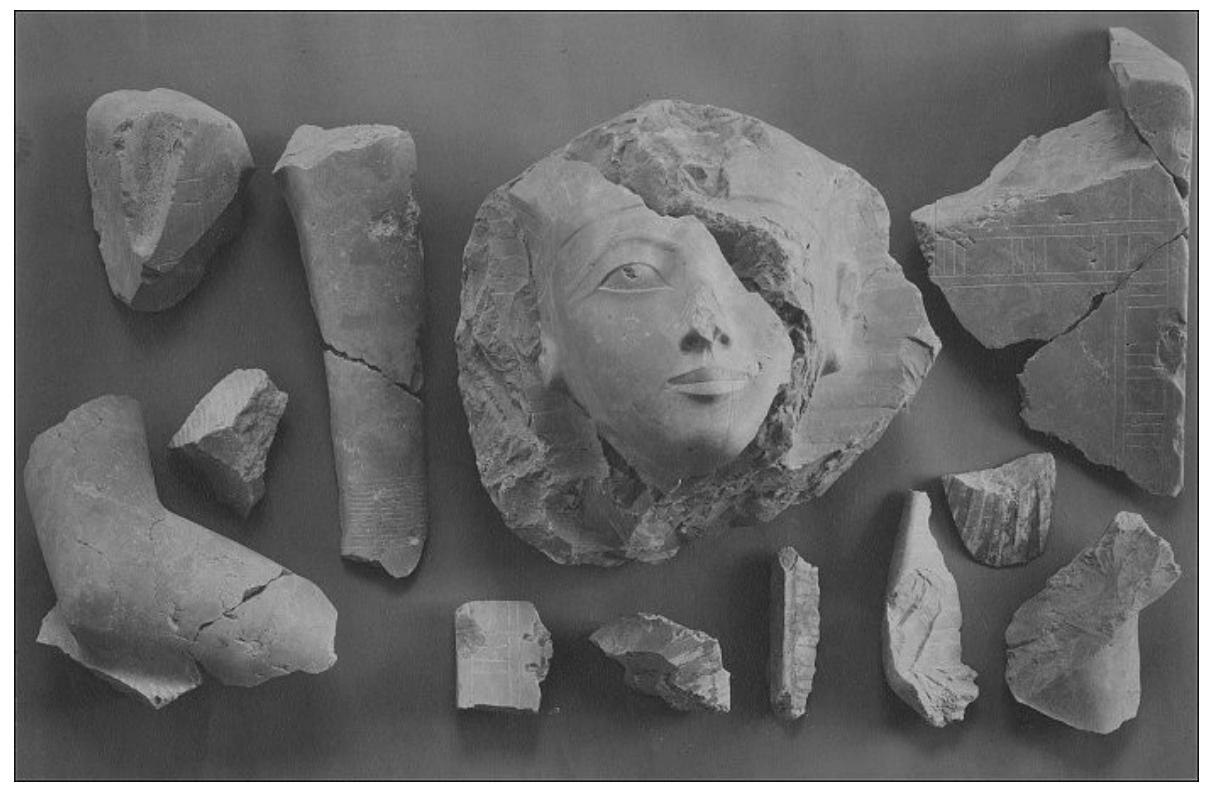
Under the orders of her successor and stepson, Thutmose III (or possibly his successor), Hatshepsut’s statues at her magnificent mortuary temple at Deir el-Bahari were violently smashed. The fragments were then unceremoniously dumped into nearby quarries and burial pits. This was not a random act of vandalism, but a highly organized political maneuver designed to rewrite the royal lineage and remove the anomaly of a female king from the official historical record.
The painstaking recovery of these statues is a triumph of modern archaeology. In the early 20th century, expeditions led by institutions such as the Metropolitan Museum of Art excavated these quarry pits, recovering thousands of shattered limestone and granite fragments. Through decades of meticulous puzzle-solving, conservators have managed to reassemble several of these magnificent sculptures. Today, the reconstructed kneeling statues of Hatshepsut, offering jars of *nu* to the god Amun, stand as powerful testaments to both ancient political ruthlessness and modern reconstructive resilience.
- Targeted Mutilation: The destruction specifically targeted the uraeus (royal cobra) and the facial features, neutralizing the statue’s spiritual power.
- Gender Representation: Hatshepsut’s statues are unique in their blend of feminine facial features with strictly masculine symbols of pharaonic power.
- Archaeological Triumphs: The reassembly of the Sphinx of Hatshepsut required matching sheer fracture lines across hundreds of scattered granite shards.
The story of Hatshepsut’s statues reminds us that ancient art was a highly charged political tool, capable of conferring divine legitimacy or being weaponized to enforce historical amnesia.

Asian Antiquities: From Indian Solar Deities to Chinese Dragons
The vast expanse of Asia holds an incredibly diverse array of sculptural traditions, deeply rooted in Hindu, Buddhist, and Daoist philosophies. Discoveries in this region often highlight the intersection of religious devotion and imperial architectural grandeur. Recent accidental unearthings and systematic restorations continue to bring extraordinary artifacts to light, reshaping our understanding of historical craftsmanship.
Whether buried under agricultural fields or hidden within the crumbling masonry of monumental walls, these artifacts speak volumes about the technological capabilities and spiritual priorities of historical Asian dynasties.
The Accidental Discovery of the 10th-Century Surya Statue
In a remarkable stroke of serendipity, a farmer in the southern Indian state of Andhra Pradesh accidentally unearthed a pristine 10th-century statue of the Hindu sun god, Surya. Discovered while plowing a field, this exquisite piece of black granite sculpture is a masterclass in medieval Indian iconography. The statue dates back to the Eastern Chalukya or Chola period, an era renowned for its highly refined stone temple architecture.
The Surya statue features the deity standing in a rigid, frontal posture (samabhanga), holding two blooming lotus flowers in his raised hands. He is flanked by his consorts, Usha and Pratyusha, who are depicted shooting arrows to dispel the darkness of dawn. At the base of the sculpture, the intricate carving reveals a chariot drawn by seven horses, symbolizing the seven days of the week and the colors of the light spectrum. The sheer detail preserved in the hard black stone is a testament to the advanced metallurgical tools and artistic training of 10th-century Indian sculptors.
The Architectural Dragon of the Jiankou Great Wall
Thousands of miles away, during restoration efforts at the treacherous Jiankou section of the Great Wall of China, workers made a stunning discovery: a beautifully carved stone dragon sculpture. Dating back to the Ming Dynasty (1368–1644), this artifact originally served as a decorative architectural finial, perched upon the roof ridge of a watchtower to ward off evil spirits and signify imperial authority.
Unlike the bronze or ceramic dragons commonly found in imperial palaces, this sculpture was carved from local stone, demonstrating the localized craftsmanship of the military garrisons stationed along the wall. The dragon features symmetrical, flowing lines, pronounced scales, and a dynamic posture that conveys a sense of protective ferocity. Its discovery within the rubble provides crucial data for historians reconstructing the original visual aesthetics of the Great Wall, proving it was not just a utilitarian military fortification, but a structure adorned with significant cultural symbolism.

Mediterranean Mysteries: The Iron Age Giants of Sardinia
The Mediterranean basin is often dominated by the classical sculptures of Greece and Rome, but the islands of the sea harbor older, more enigmatic traditions. On the Italian island of Sardinia, the Nuragic civilization flourished during the Bronze and Iron Ages, leaving behind thousands of mysterious stone towers known as nuraghi. However, it is their monumental stone sculptures that have recently captivated the archaeological world.
Discovered in the necropolis of Mont’e Prama, these statues represent one of the most significant and perplexing archaeological finds in the western Mediterranean. The sheer scale and unique stylization of these figures have sparked intense debate among historians regarding their true identity and purpose.
Unearthing the Giants of Mont’e Prama
First discovered by farmers in 1974, the site of Mont’e Prama yielded over 5,000 limestone fragments. After decades of painstaking restoration, researchers reassembled these fragments into dozens of massive statues, standing over two meters tall. Known colloquially as the “Giants of Mont’e Prama,” these 8th-century BC sculptures depict boxers holding shields over their heads, archers with bows, and warriors wielding swords.
The most striking feature of these giants is their faces: perfectly circular, concentric eyes that lend them an almost alien, robotic appearance. A bold new theory suggests that rather than depicting mythological heroes or gods, these statues represent real-life aristocratic warriors of the Nuragic elite. This hypothesis posits that the statues were part of a grand ancestral cult, erected to guard the tombs of fallen chieftains and project power to rival factions.
- Concentric Eyes: The geometric precision of the eyes suggests the use of advanced compass-like tools during the Iron Age.
- Martial Prowess: The detailed depiction of armor, horned helmets, and specific weaponry provides a literal snapshot of Nuragic military technology.
- Cultural Isolation vs. Exchange: While uniquely Sardinian, the statues show faint stylistic echoes of Eastern Mediterranean and Etruscan art, hinting at ancient maritime trade networks.
The Giants of Mont’e Prama force a reevaluation of Iron Age Mediterranean history, proving that monumental stone statuary existed in western Europe centuries before the classical Greek kouros figures.

South American Secrets: The Wooden Guardians of Chan Chan
While stone and clay are the most common mediums to survive the ravages of time, the arid desert coasts of South America occasionally offer up incredibly rare organic artifacts. In the ancient ruined city of Chan Chan, located in modern-day Peru, archaeologists recently unearthed a remarkably preserved wooden sculpture dating back over 850 years.
Chan Chan was the sprawling adobe capital of the Chimú civilization, which dominated the northern coast of Peru before being conquered by the Inca Empire. The city is famous for its intricate mud-brick friezes, but the discovery of intact wooden artifacts provides a highly intimate look at their ceremonial practices.
Chimú Craftsmanship and Ceremonial Artifacts
The unearthed wooden sculpture, measuring approximately 47 centimeters in height, was discovered in a ceremonial complex known as Huaca Takaynamo. The figure depicts a human carrying a marine shell or a cup, wearing a trapezoidal mask, and adorned with a tunic. Notably, the base of the sculpture was embedded in a red clay pedestal, indicating it was a fixed idol used in religious rituals.
The preservation of this wooden artifact is entirely due to the hyper-arid climate of the Peruvian coast. The sculpture provides crucial evidence of the Chimú’s reverence for the ocean, which was their primary source of sustenance and a central element of their cosmology. The presence of the marine shell in the figure’s hands highlights the importance of maritime resources and ritual offerings to water deities in an otherwise unforgiving desert environment.

The Evolution of Art: Painted Statues and Lifelike Human Sculptures
For centuries, the modern world held a profound misconception about ancient sculpture: the belief that classical statues were intended to be pristine, unpainted white marble. This aesthetic ideal, championed during the Renaissance and Neoclassical periods, fundamentally misunderstood the ancient world. The reality is that the ancient world was vibrantly—sometimes garishly—colorful.
Recent advancements in ultraviolet imaging, X-ray fluorescence, and microscopic pigment analysis have definitively proven the extensive use of polychromy (painting in multiple colors) in ancient statues. From the lifelike human sculptures of ancient Greece to the painted wooden figures of Mesoamerica, color was an essential component of sculptural realism.
Breaking the Myth of Pristine White Marble
The first painted statues and lifelike human sculptures were designed to mimic reality as closely as possible. Ancient artisans applied thick layers of paint, utilized gold leaf for jewelry, and even inserted glass or polished stones for eyes to create a startlingly lifelike gaze. The paint also served to highlight intricate details, such as the patterns on clothing or the texture of hair, which are invisible on bare stone.
This revelation completely alters how we interpret ancient art. A stark white marble statue projects an aura of cold, abstract idealism. In contrast, a brightly painted statue—with flesh-toned skin, crimson lips, and vibrant blue robes—projects a visceral, immediate human presence. The fading of these pigments over millennia created a false historical narrative that archaeologists and art historians are now actively correcting.
- Pigment Traces: Egyptian blue, madder lake, and ochre are frequently detected in the microscopic crevices of ancient marble and stucco.
- Emotional Impact: Polychromy was used to evoke specific emotional responses from ancient viewers, making deities appear more terrifying and rulers more majestic.
- Technological Revelation: The binders used to attach pigments to stone reveal advanced chemical knowledge in ancient societies.
Understanding the true, colorful nature of ancient sculptures bridges the psychological gap between the modern observer and the ancient artist, revealing a shared human desire for vivid, lifelike representation.

Comparative Analysis of Global Archaeological Artifacts
To fully appreciate the magnitude of these global discoveries, it is essential to analyze them side-by-side. While separated by oceans and millennia, these artifacts share common themes: the assertion of power, the veneration of the divine, and the human struggle against mortality. By organizing these discoveries categorically, we can observe the parallel evolution of human craftsmanship.
The following table provides a high-level comparative analysis of the key sculptures discussed, highlighting their diverse origins, materials, and primary cultural significance.
| Artifact / Discovery | Civilization / Era | Material |
|---|