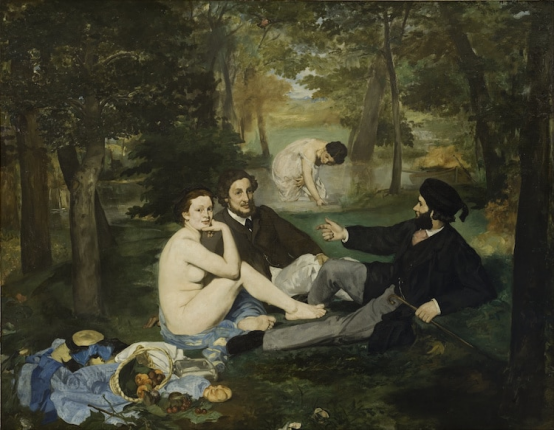
Édouard Manet’s “Le Déjeuner sur l’herbe” (Luncheon on the Grass) stands as one of the most significant turning points in the history of art. Originally titled “Le Bain,” the large-scale oil painting caused an unprecedented scandal when it was first exhibited in 1863. It did not merely break a few rules; it dismantled the entire foundation of the French Academy’s aesthetic standards. To understand the “Pillar of Modernism,” one must look beyond the canvas to the social and political climate of 19th-century Paris, where the tension between tradition and innovation reached a breaking point.
The Historical Catalyst: The Salon des Refusés of 1863
In the mid-19th century, the Académie des Beaux-Arts governed the French art world. Their annual exhibition, the Salon, was the only way for an artist to achieve professional success. In 1863, the Salon jury rejected over 3,000 works, including Manet’s masterpiece. The outcry from the rejected artists was so significant that Emperor Napoleon III authorized a separate exhibition: the Salon des Refusés (Exhibition of the Rejects).
The Public Reaction
While the Salon des Refusés was intended to let the public judge the quality of the work for themselves, it largely became a venue for ridicule. Manet’s “Luncheon on the Grass” was the center of this storm. Viewers were not just confused; they were offended. The juxtaposition of a nude woman with fully dressed contemporary men was seen as a moral affront, lacking the “justification” of mythological or historical context.
The Shift in Patronage
This moment signaled the beginning of the end for the Academy’s monopoly. By showcasing works that did not fit the “idealized” mold, Manet and his contemporaries proved that art could exist outside the strictures of state-sponsored approval, eventually leading to the independent exhibitions of the Impressionists a decade later.
Radical Aesthetics: Why the Painting Shocked the World
The controversy of “Le Déjeuner sur l’herbe” was as much about technique as it was about subject matter. Manet intentionally abandoned the “finish” expected of a professional painting, opting instead for a style that felt immediate and confrontational.
The Rejection of Chiaroscuro
Traditional painting relied on “chiaroscuro”—the gradual transition from light to dark to create the illusion of three-dimensional volume. Manet rejected this. He used harsh, frontal lighting that flattened the figures, making the nude woman appear stark and two-dimensional. This was a deliberate nod to the “flatness” of the canvas, a core tenet of what would become Modernism.
The Confrontational Gaze
The female figure, Victorine Meurent, does not look away modestly as was common in classical nudes. She looks directly at the viewer. This “confrontational gaze” stripped away the voyeuristic safety of the audience, forcing them to acknowledge her presence as a contemporary Parisian woman rather than a distant goddess.
| Feature | Academic Tradition | Manet’s Modernism |
|---|---|---|
| Subject Matter | Mythological or Historical | Contemporary, Everyday Life |
| Lighting | Soft, Graduated Shadows | Stark, Flat, Frontal Light |
| Brushwork | Invisible, Polished Finish | Visible, Sketch-like Strokes |
| Perspective | Deep, Realistic Space | Compressed, Inconsistent Depth |
The Enduring Legacy: Bridging Realism and Impressionism
Manet is often described as the “Father of Modernism,” though he never officially joined the Impressionist group. He remained a bridge between the Realism of Gustave Courbet and the atmospheric explorations of Claude Monet.
Influence on the Impressionists
Younger artists like Monet, Renoir, and Pissarro saw in Manet a hero who had the courage to paint “modern life.” His use of bright colors and his willingness to leave brushstrokes visible gave them the “permission” to further experiment with light and movement. Without the shock of “Luncheon on the Grass,” the Impressionist movement might never have gained the momentum needed to change the world.
Expert Advice: How to Analyze Manet
-
Look for the Disconnect:
Notice how the four figures do not seem to be interacting. This “psychological isolation” is a hallmark of modern urban life. -
Observe the Still Life:
The discarded clothes and fruit in the lower-left corner are a “painting within a painting,” showcasing Manet’s incredible technical skill despite his “unfinished” style elsewhere. -
Identify the Source:
Manet was actually referencing Titian’s “Pastoral Concert” and Raphael’s “Judgment of Paris.” He wasn’t ignoring history; he was “updating” it for the 19th century.
Frequently Asked Questions (FAQ)
-
Why was the painting considered a scandal in 1863?
- It was scandalous because it depicted a nude woman in a contemporary setting with two clothed men. In the 19th century, nudity was only acceptable if the woman represented a goddess or a nymph. By making her a real, modern person, Manet was accused of depicting “vulgarity.”
-
Who are the people in the painting?
- The nude woman is Victorine Meurent, Manet’s favorite model. The two men are Manet’s brother, Eugène, and his future brother-in-law, Ferdinand Leenhoff. The woman in the background is also a known model of the period.
-
Is the perspective in the painting “wrong”?
- The perspective is intentionally distorted. The woman bathing in the background is far too large for her distance from the foreground group. Manet did this to challenge the traditional “window into the world” style of painting, emphasizing that the painting is a flat surface covered in pigment.
-
Where can I see the original painting today?
- The original “Le Déjeuner sur l’herbe” is a permanent part of the collection at the Musée d’Orsay in Paris, France.
-
How did this painting lead to Impressionism?
- It broke the “rules” of the Salon, encouraging younger artists to focus on modern subjects, use brighter palettes, and value the artist’s individual “impression” over a realistic, photographic finish.