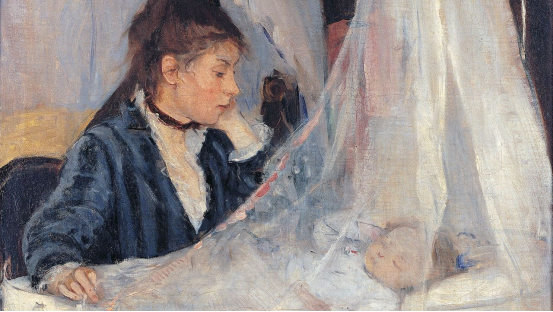
Berthe Morisot’s “The Cradle” (Le Berceau), painted in 1872, stands as a quintessential work of Impressionism and a profound testament to the female experience within a rapidly changing artistic landscape. More than just a beautiful depiction of domestic life, this masterpiece offers a gentle yet revolutionary gaze into the intimate world of a mother and child, challenging the prevailing artistic conventions of its time. This ultimate guide will delve deep into the painting’s historical context, Morisot’s groundbreaking techniques, and the enduring significance of her unique contribution to the Impressionist movement and art history at large. We will explore “The Cradle” not merely as a painting, but as a window into the life and perspective of one of art’s most important, yet often understated, trailblazers.
Berthe Morisot: The Trailblazing Female Impressionist
Berthe Morisot (1841–1895) was not just an Impressionist painter; she was a pivotal figure who navigated and ultimately reshaped the male-dominated art world of 19th-century France. Born into an affluent bourgeois family, Morisot’s artistic aspirations were initially met with the societal constraints placed upon women of her class. However, her unwavering dedication and exceptional talent allowed her to transcend these limitations, forging a path that would inspire generations.
Early Life and Artistic Training
Morisot’s artistic journey began formally at an early age, a privilege afforded by her family’s status. Unlike many male artists who attended prestigious academies like the École des Beaux-Arts, women were largely excluded from such institutions, particularly from life drawing classes that were deemed inappropriate. Morisot, alongside her sister Edma, received private lessons, studying under notable artists such as Joseph Guichard, Geoffroy-Alphonse Chocarne, and most significantly, Jean-Baptiste-Camille Corot, a master of the Barbizon School. Corot’s emphasis on painting “en plein air” (outdoors) and capturing atmospheric effects profoundly influenced Morisot’s developing style, laying the groundwork for her eventual embrace of Impressionism.
Breaking Barriers in a Male-Dominated Art World
Despite the societal expectations for women to marry and manage a household, Morisot pursued her artistic career with tenacity. She exhibited her work at the official Salon de Paris from 1864 to 1874, gaining recognition and critical acclaim. Her decision to join the independent group of artists who would become known as the Impressionists, participating in their first exhibition in 1874 – the only woman to do so – was a radical act. This bold move signaled her rejection of academic conservatism and her commitment to a new, revolutionary artistic vision. Her marriage to Eugène Manet, brother of Édouard Manet, further solidified her connections within the avant-garde circle, but she always maintained her distinct artistic identity.
Morisot’s Unique Contribution to Impressionism
Morisot’s Impressionism was characterized by its delicate brushwork, luminous palette, and a particular focus on themes of domesticity, motherhood, and female leisure. While male Impressionists often depicted urban landscapes, cafés, and bustling public spaces, Morisot’s subjects were drawn from her immediate environment: her home, garden, and family members. This choice was partly due to social restrictions, but it also allowed her to explore a rich inner world, capturing fleeting moments of intimacy and reflection with unparalleled sensitivity. Her work offers a vital counterpoint to the male gaze prevalent in art history, presenting a nuanced and empathetic portrayal of women’s lives.
“The Cradle” (Le Berceau): A Masterpiece of Intimacy and Observation
Among Morisot’s extensive oeuvre, “The Cradle” stands out as a seminal work, encapsulating her artistic philosophy and technical prowess. Painted during a period of intense personal change and artistic maturation, it is a deeply personal piece that resonates with universal themes of motherhood and protection.
Context and Creation of the Painting
“The Cradle” was painted in 1872, a year after Morisot married Eugène Manet. The subject of the painting is her sister, Edma Pontillon, gazing tenderly at her sleeping infant daughter, Blanche. Edma, herself an accomplished artist who had to abandon her career after marriage, often served as Morisot’s model and confidante. The painting was exhibited at the first Impressionist exhibition in 1874, drawing attention for its unconventional subject matter and innovative style. Its creation reflects Morisot’s deep connection to her family and her desire to elevate the intimate moments of everyday life into high art.
Composition and Subject Matter: Edma and Blanche
The composition of “The Cradle” is both simple and profound. Edma, positioned on the left, leans over the cradle, her gaze fixed on her sleeping child. Her posture conveys a quiet intensity, a blend of love, watchfulness, and perhaps a touch of melancholy. The diagonal lines of the curtain and the cradle itself draw the viewer’s eye towards the infant Blanche, who is delicately swaddled and bathed in soft light. Morisot masterfully uses light and shadow to create depth and emphasize the serenity of the scene. The subtle interplay of colors – whites, creams, and muted blues – contributes to the painting’s ethereal quality, suggesting a dreamlike state.
The Psychology of Motherhood and Domesticity
Beyond its aesthetic beauty, “The Cradle” offers a poignant psychological study of motherhood. It captures a moment of profound connection and quiet contemplation, a universal experience that transcends time and culture. Morisot’s portrayal is devoid of sentimentality; instead, it offers an honest and empathetic glimpse into the emotional landscape of a new mother. The painting celebrates the quiet heroism of domestic life, asserting its artistic validity in a world that often dismissed it as trivial. It subtly challenges the notion that only grand historical or mythological scenes held artistic merit, advocating for the beauty and significance of the everyday.
Technical Checklist: Analyzing “The Cradle”‘s Impressionist Elements
- Brushwork: Loose, visible brushstrokes, particularly in the drapery and background, to capture light and movement rather than precise detail.
- Light: Soft, diffused, and natural light, suggesting an indoor setting with light filtering through a window, creating a gentle luminosity.
- Color Palette: Predominantly light and airy tones – whites, creams, soft blues, and muted greens – contributing to the painting’s gentle and intimate mood.
- Composition: Asymmetrical balance, with the figures positioned to one side, creating a sense of naturalism and immediacy, as if catching a fleeting moment.
- Perspective: Shallow depth of field, bringing the viewer close to the intimate scene without distant vanishing points, enhancing the sense of proximity.
- Subject Matter: Focus on an intimate, everyday domestic scene, a hallmark of Impressionism’s shift away from academic historical or mythological themes.
- Sense of Movement/Time: The “snapshot” quality, capturing a specific, transient moment in time, a key characteristic of Impressionist intent.
Impressionism Through a Female Lens: Morisot’s Distinctive Gaze
Morisot’s “The Cradle” is not