The Impressionist Foundation: Understanding Alfred Sisley
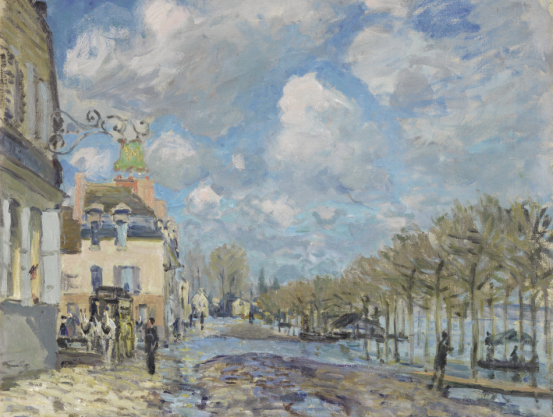
Alfred Sisley, often overshadowed by his contemporaries Monet and Renoir, remains the most consistent of the Impressionists. His focus was almost exclusively on the landscape, capturing the transient effects of light and weather with a precision that bordered on the obsessive. Unlike his peers who sought social commentary or urban spectacle, Sisley found beauty in the mundane, the flooded village, and the quiet, decaying structures of the French countryside.
The Philosophy of the Transient Landscape
Sisley’s work serves as a historical precursor to what we now identify as “minimalist disaster aesthetics.” By focusing on the raw interaction between human architecture and unpredictable nature—specifically in his depictions of the great floods of the 1870s—he stripped away the romanticism of the era. He presented the disaster not as a chaotic event, but as a quiet, structural reconfiguration of the world.
Decoding Minimalist Disaster Aesthetics
Minimalist disaster aesthetics is a contemporary conceptual framework that finds beauty in the intersection of structural simplicity and cataclysmic disruption. It is the art of seeing the “clean” lines of a destroyed or abandoned space. If Sisley were a blogger today, his feed would likely be a curated collection of flooded streets, architectural ruins, and the stark, lonely light that follows a natural event.
Key Elements of the Aesthetic
- Structural Isolation: Focusing on a single, isolated building against a backdrop of environmental shift.
- Chromatic Restraint: Using a limited, muted color palette to emphasize atmosphere over vibrant detail.
- The Absence of Human Subjectivity: Allowing the landscape to “speak” for itself without the distraction of figures.
- Temporal Stillness: Capturing the moment of pause after the event, rather than the violence of the event itself.
Comparative Analysis: 19th Century vs. Modern Digital Trends
| Feature | Alfred Sisley (19th Century) | Modern Digital Minimalism |
|---|---|---|
| Medium | Oil on Canvas | High-Resolution Photography / Digital Art |
| Focus | Atmospheric Light | Texture and Negative Space |
| Theme | Natural Resilience | Structural Fragility |
| Disaster Representation | Literal (Floods, Snow) | Conceptual (Urban Decay, Minimalism) |
Pro Tips for Curating Aesthetic Landscapes
To effectively analyze or create content within the realm of minimalist disaster aesthetics, one must prioritize the “less is more” philosophy. Focus on the geometry of ruins, the way light interacts with stagnant water, and the exclusion of extraneous details that don’t serve the core narrative of the scene.
Frequently Asked Questions (FAQ)
- What is minimalist disaster aesthetics?
- It is an artistic approach that emphasizes the stark, clean beauty found within scenes of decay, destruction, or natural upheaval, stripping away the chaos to focus on form and atmosphere.
- Why is Alfred Sisley considered a pioneer of this style?
- Sisley’s ability to capture the quiet, repetitive, and often somber nature of floods and harsh weather provided a blueprint for focusing on the structural impacts of disaster rather than the human drama.
- How can digital creators apply these principles?
- By utilizing high-contrast, low-saturation editing and focusing on the interplay between architecture and environmental elements, creators can evoke a sense of “quiet disaster” in their photography or design work.
- What is the core difference between Impressionism and this aesthetic?
- While Impressionism is concerned with the subjective experience of light and color, minimalist disaster aesthetics is concerned with the objective reality of the subject matter—often leaning toward a colder, more detached perspective.