When I was sorting out art history materials last week, Tang Sancai suddenly caught my eye. As a representative art form of the Tang Dynasty, it has many details worth exploring.
Basic knowledge of Tang Sancai
Tang Sancai, “Sancai” does not refer to three colors, but means colorful, mainly yellow, green and white, but also includes blue, brown and other colors. It was born in the Tang Dynasty (618-907 AD) and is a low-temperature lead-glazed pottery. At that time, the Tang Dynasty was strong and exchanges between China and foreign countries were frequent. Ceramic technology developed rapidly under such a background, and Tang Sancai came into being.
Tang Sancai was mostly used as funerary objects and buried with the dead. In the Tang Dynasty, lavish burials were prevalent, and nobles and wealthy families hoped that through exquisite burial objects, the deceased could enjoy a rich life in the other world. With its rich colors and diverse shapes, Tang Sancai became a popular choice for burial objects. At the same time, a small amount of Tang Sancai was also used for daily decoration, but due to its high production cost, it was not widely popularized.
Production process
The production process of Tang Sancai is very particular. First, the body is made. The craftsmen use fine white clay and make various shapes of pottery through processes such as kneading and shaping. After the pottery is formed, it must be bisque fired at a temperature between 1000℃ and 1100℃ to give the pottery a certain strength and hardness.
After the bisque firing is completed, the glazing phase begins. The craftsmen mix glazes containing metal oxides such as copper, iron, and manganese in different proportions and apply or sprinkle them on the pottery. During the firing process, these metal oxides will present different colors due to changes in temperature and atmosphere. The last step is glaze firing, which is slightly lower than bisque firing, at about 800°C. In this process, the glaze melts and flows, infiltrating each other, forming a unique color blending effect. The color distribution of each Tang Sancai finished product is unique.
Modeling type and characteristics
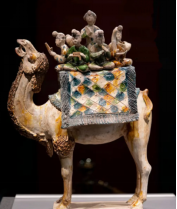
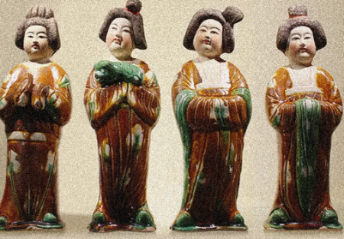
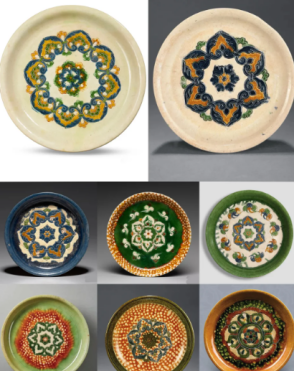
The shapes of Tang Sancai are rich and varied, and can generally be divided into four categories: daily necessities, models, figures, and animals. Animals are the most common, with horses being the most common, followed by camels, which may be related to the background of the time. Figures are generally court maids. The shapes of Tang Sancai objects are round and full, which is consistent with the full, healthy, and broad characteristics of Tang Dynasty art. The proportions of Sancai figures and animals are moderate, the shapes are natural, the lines are smooth, and they are lively.