René Magritte stands as one of the most intellectually provocative figures of the Surrealist movement. Unlike his contemporaries who relied heavily on dreamscapes and the bizarre, Magritte utilized ordinary, everyday objects—apples, pipes, bowler hats, and candles—to orchestrate profound philosophical inquiries. His work does not merely ask us to look; it demands that we question the very nature of what we are looking at. By systematically dismantling the boundaries between language, image, and reality, Magritte forces the viewer into a state of cognitive dissonance. This comprehensive analysis dissects three of his most pivotal works—The Treachery of Images, The Son of Man, and Night of Love—revealing the intricate psychological and semiotic layers that define his enduring legacy.
The Treachery of Images: Deconstructing Visual and Linguistic Reality
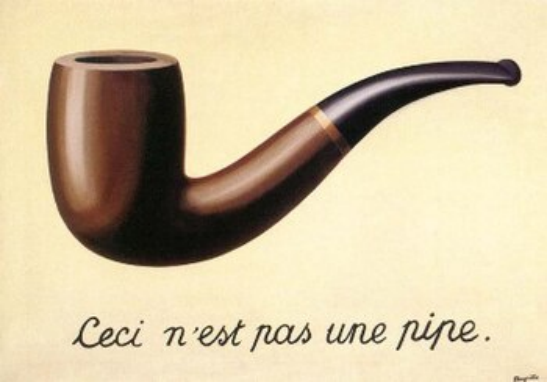
Perhaps no other painting in modern art history encapsulates the intersection of linguistics and visual representation quite like Magritte’s 1929 masterpiece, The Treachery of Images. Featuring a highly realistic depiction of a smoker’s pipe suspended above the cursive text “Ceci n’est pas une pipe” (This is not a pipe), the artwork serves as a foundational text for visual semiotics. Magritte deliberately weaponizes the viewer’s assumptions, creating a paradoxical loop that forces us to confront the inherent betrayal of both images and language.
The Semiotic Rebellion of “Ceci n’est pas une pipe”
To understand the profound impact of this work, one must delve into the mechanics of semiotics—the study of signs and symbols. When a viewer looks at the canvas, the immediate neurological response is to identify the object as a pipe. However, Magritte’s accompanying text abruptly halts this assumption. He reminds us that we are not looking at a physical object that can be stuffed with tobacco and smoked; rather, we are looking at a two-dimensional arrangement of oil paint on canvas. The image is merely a signifier, entirely divorced from the physical reality of the signified.
This deliberate contradiction highlights several crucial philosophical concepts regarding human perception:
- The Illusion of Representation: Art, no matter how hyper-realistic, is fundamentally an illusion. Magritte exposes the lie of traditional representational art, which attempts to convince the viewer that the canvas is a window into reality.
- The Arbitrary Nature of Language: By explicitly denying the object’s identity through text, Magritte questions the authority of language. Words are merely arbitrary labels assigned to objects, lacking any inherent connection to the physical world.
- Cognitive Dissonance as an Artistic Tool: The friction between the visual input (the pipe) and the linguistic input (the denial of the pipe) creates a psychological tension. This tension is the true subject of the painting, forcing the viewer into an active state of philosophical inquiry.
Through this masterful juxtaposition, Magritte effectively dismantles the viewer’s reliance on empirical observation. He proves that our understanding of reality is heavily mediated by arbitrary symbols, leading to a profound skepticism of both the visual and the verbal worlds.
Foucault and the Betrayal of the Canvas
The philosophical weight of The Treachery of Images is so immense that it prompted the renowned French philosopher Michel Foucault to write a book-length essay on the subject. Foucault argued that Magritte’s painting breaks the traditional bond between text and image. Historically, text in art was used to clarify, title, or explain the visual element. Magritte, however, uses text to sabotage the image. The cursive handwriting, reminiscent of a primary school chalkboard, adds a layer of institutional authority to the denial, further complicating the viewer’s relationship with the artwork. It is a masterclass in the subversion of didactic norms.

The Son of Man: Voyeurism and the Eternal Conflict of the Hidden
Painted in 1964 as a self-portrait, The Son of Man is arguably Magritte’s most recognizable and heavily referenced work. It features a man in an overcoat and a bowler hat standing in front of a low sea wall and a cloudy sky. However, his face is almost entirely obscured by a hovering green apple. This painting is a profound exploration of human curiosity, the psychological weight of anonymity, and the tantalizing nature of the hidden versus the visible.
The Green Apple: A Symbol of Distraction and Desire
The placement of the green apple is a stroke of surrealist genius. It covers the most crucial element of human connection and identity: the face. By obscuring the subject’s features, Magritte taps into a universal psychological frustration. The viewer’s eye is naturally drawn to the face, but it is blocked by an object of the natural world. The apple itself carries immense symbolic weight, often associated with biblical temptation, knowledge, and the fall of man. In this context, the apple represents the distractions and literal barriers that prevent us from achieving true understanding and connection with one another.
Magritte himself explained the phenomenon perfectly, stating that everything we see hides another thing, and we always want to see what is hidden by what we see. This creates an intense, almost voyeuristic desire within the viewer. We are compelled to peer around the apple, to catch a glimpse of the eyes (the left eye barely peeking through the leaves) to unravel the mystery of the anonymous figure.
The Bowler Hat and Bourgeois Anonymity
The attire of the figure in The Son of Man is equally significant. The bowler hat and overcoat were the standard uniform of the middle-class bureaucrat in mid-20th-century Europe. By dressing his subject in this manner, Magritte strips him of individuality. The man becomes a universal placeholder, an Everyman navigating the absurdities of modern life.
This deliberate anonymity serves multiple thematic purposes:
- The Loss of Individuality: The uniform attire suggests a critique of societal conformity, where individuals are reduced to interchangeable cogs within the bourgeois machine.
- The Universal Subject: Because the man could be anyone, the viewer is invited to project their own anxieties and identities onto the canvas. The obscured face becomes a mirror for our own hidden selves.
- Surrealism in the Mundane: Unlike Salvador Dalí’s melting clocks, Magritte’s surrealism relies on the hyper-ordinary. The bowler hat grounds the image in stark reality, making the floating apple all the more jarring and unsettling.
The tension in The Son of Man lies in its quietness. There is no violent action, only a static, eternal standoff between the desire to see and the impossibility of seeing. It is a masterpiece of psychological withholding, transforming the viewer into an unwitting voyeur desperately trying to penetrate a veil that can never be lifted.
Night of Love: Illumination, Textures, and Subconscious Desire
While perhaps less universally recognized than the pipe or the apple, Magritte’s Night of Love (La Nuit d’Amour) is a vital component of his oeuvre, offering a deeper dive into the poetic and romantic dimensions of his surrealist vision. This work often features the haunting juxtaposition of disparate elements, such as green feathers and candlelight, creating an atmosphere charged with psychological tension and subconscious desire.
The Poetics of Incompatible Elements
Magritte’s methodology often involved the “isolation” or “modification” of objects to strip them of their conventional utility. In Night of Love, the presence of elements like candlelight and feathers speaks to a sensory and tactile surrealism. A burning candle traditionally symbolizes illumination, the passage of time, or spiritual presence. When paired with the soft, organic texture of green feathers, the painting evokes a dream state where the rules of the physical world are suspended.
The title itself, Night of Love, acts as an emotional anchor. Magritte frequently assigned poetic titles to his works after they were completed, often relying on the suggestions of his literary friends. The title forces the viewer to interpret the inanimate objects through the lens of human passion, intimacy, and perhaps the fleeting nature of romance. The warmth of the candle against the cool, unexpected presence of green feathers creates a sensory paradox that mimics the irrational landscape of human desire.
Illuminating the Depths of the Subconscious
Surrealism was heavily influenced by Freudian psychoanalysis, particularly the belief that the subconscious mind holds the key to true human nature. Night of Love operates as a visual representation of a dream sequence. The illumination provided by the candlelight does not reveal a logical room; instead, it highlights the absurdity of the objects within it.
This interplay of light and texture serves to:
- Evoke Emotional Resonance: The soft lighting and delicate feathers create an atmosphere of vulnerability, contrasting sharply with the clinical detachment seen in works like The Treachery of Images.
- Challenge Spatial Reality: Magritte often manipulated scale and environment. The objects in Night of Love exist in a liminal space, divorced from a recognizable domestic setting, emphasizing their symbolic rather than literal importance.
- Manifest the Intangible: Love and passion are abstract concepts. By using specific, albeit strangely paired, physical objects, Magritte attempts to give form to the formless, capturing the irrationality of emotional experience.
Through Night of Love, Magritte demonstrates that his surrealism is not solely intellectual; it is deeply rooted in the evocative power of poetry and the mysterious depths of the human heart.
The Enduring Legacy of Magritte’s Philosophical Surrealism
René Magritte’s influence extends far beyond the confines of early 20th-century art movements. His meticulous deconstruction of reality, language, and perception laid the groundwork for subsequent generations of artists, philosophers, and even commercial advertisers. By refusing to provide easy answers, Magritte ensured that his work would remain eternally relevant.
Influence on Pop Art and Contemporary Visual Culture
The repetitive, deadpan presentation of ordinary objects in Magritte’s work directly anticipated the Pop Art movement. Artists like Andy Warhol and Jasper Johns drew heavily on Magritte’s treatment of the mundane as a subject worthy of intense scrutiny. Furthermore, Magritte’s visual puns and paradoxes have been endlessly co-opted by modern advertising, which frequently uses his techniques of juxtaposition and cognitive dissonance to capture consumer attention.
To fully grasp the multi-dimensional impact of the three masterpieces discussed, we can observe their thematic intersections in the following comparative analysis:
| Artwork | Core Symbolic Elements | Primary Philosophical Theme | Psychological Impact on Viewer |
|---|---|---|---|
| The Treachery of Images | Smoking pipe, cursive text | The gap between language, image, and physical reality | Cognitive dissonance, skepticism of visual truth |
| The Son of Man | Bowler hat, green apple, obscured face | Voyeurism, anonymity, the conflict of the hidden vs. visible | Frustration, curiosity, self-reflection |
| Night of Love | Candlelight, green feathers | Subconscious desire, the poetry of incompatible textures | Emotional resonance, dream-like disorientation |
Ultimately, René Magritte teaches us that the world is not as it seems. His paintings are not windows into a fantastical realm, but rather mirrors reflecting the absurdity, mystery, and profound complexity of our own reality. By challenging us to look closer, to question our assumptions, and to embrace the unknown, Magritte solidifies his position as a true architect of modern thought.
Frequently Asked Questions (FAQ)
- What is the main message behind “The Treachery of Images”?
- The primary message is a critique of representation and human perception. Magritte uses the text “This is not a pipe” below a painting of a pipe to remind the viewer that the artwork is merely a representation (an illusion made of paint), not the physical object itself. It highlights the arbitrary relationship between language, images, and reality.
- Why did Magritte use a green apple to cover the face in “The Son of Man”?
- The green apple acts as a physical and psychological barrier. It plays on the human desire to see what is hidden. Symbolically, the apple can represent worldly distractions, temptation, or the forces of nature that obscure true human identity and connection, leaving the viewer in a state of perpetual curiosity and voyeurism.
- How does “Night of Love” differ from Magritte’s more famous works?
- While works like “The Treachery of Images” are highly intellectual and semiotic, “Night of Love” leans more heavily into the poetic and emotional aspects of surrealism. It relies on the tactile and visual juxtaposition of elements like candlelight and green feathers to evoke a dreamlike atmosphere, focusing on subconscious desire and romantic melancholy rather than linguistic paradoxes.
- What is the significance of the bowler hat in Magritte’s paintings?
- The bowler hat, frequently seen in works like “The Son of Man” and “Golconda,” represents the bourgeois Everyman. It was standard middle-class attire during Magritte’s time. By using it, Magritte strips his subjects of their individuality, creating anonymous figures that represent societal conformity while allowing viewers to project their own identities onto the canvas.