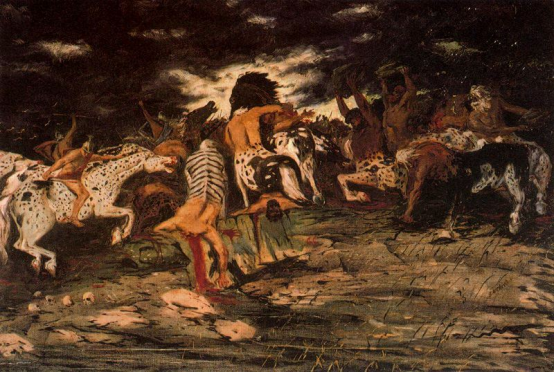
Giorgio de Chirico remains one of the most enigmatic figures in 20th-century art, serving as the primary architect of the Metaphysical Art movement (Pittura Metafisica). His work does not merely depict scenes; it constructs “dream architectures” where time is suspended and reality is refracted through the lens of memory and mythology. By stripping objects of their conventional contexts, de Chirico invites the viewer into a “second reality” that exists beneath the surface of the physical world. This long-form analysis explores the intricate logical branches of his most famous compositions, examining how he fused the classical past with a haunting, modern sense of existential dread.
The Metaphysical Town Square: Analyzing Mystery and Melancholy of a Street
Perhaps no painting encapsulates the essence of de Chirico’s vision more effectively than “Mystery and Melancholy of a Street” (1914). The work is a masterclass in the use of perspective to create psychological unease. Rather than a realistic depiction of an Italian piazza, the painting presents a distorted, claustrophobic space that feels more like a stage set than a city. The sharp, elongated shadows and the high-contrast lighting suggest a late afternoon sun that never sets, trapping the subjects in a state of eternal waiting.
The Symbolism of the Girl and the Hoop
At the heart of the composition is a young girl silhouetted against the bright ground, rolling a hoop toward a dark, looming shadow. This figure is often interpreted as a symbol of lost innocence or the vulnerability of the individual within the vast, uncaring machinery of the city. The hoop, a perfect circle, contrasts with the rigid, linear perspective of the surrounding arcades, representing a fleeting moment of play in a world dominated by architectural coldness. Her movement toward the unseen shadow—likely that of a classical statue—creates a narrative tension that is never resolved, embodying the “mystery” mentioned in the title.
The Dark Van and Architectural Geometry
To the right of the girl sits an empty, dark horse-drawn van or wagon. This element introduces a sense of displacement. In the early 20th century, such vans were common, yet in de Chirico’s hands, it becomes an ominous vessel, its open doors suggesting a void or a portal to another dimension. The architecture itself, characterized by deep arcades and repetitive arches, draws the eye toward a vanishing point that offers no escape. This geometric precision is intentionally “wrong,” utilizing multiple vanishing points to disorient the viewer and evoke the illogical structure of a dream.

Myth and Reality: The Confluence of The Chariot and the Faun
In his later explorations, de Chirico moved toward a more explicit integration of classical mythology, as seen in “The Chariot and the Faun.” This work exemplifies the “confluence of myth and reality,” where ancient symbols are placed in desolate, modern landscapes. The faun, a creature of wild nature and unbridled instinct, is juxtaposed against the chariot, a symbol of human conquest, technology, and the passage of time. This intersection creates a profound dialogue between the primordial past and the stagnant present.
The Faun as a Guardian of the Metaphysical
The faun in de Chirico’s work is rarely depicted in a state of Dionysian frenzy. Instead, it often appears as a statue or a frozen figure, acting as a guardian of the metaphysical realm. This “petrification” of myth suggests that the ancient world is not dead but has become part of the silent, architectural fabric of our consciousness. By placing the faun within a contemporary setting, de Chirico highlights the alienation of modern man from his mythological roots, suggesting that while the symbols remain, their original vitality has been replaced by a haunting stillness.
Temporal Suspension and the Chariot
The chariot, traditionally a vehicle of movement and speed, is rendered stationary in de Chirico’s compositions. This is a recurring theme in Metaphysical art: the suspension of time. By depriving a vehicle of its function, the artist forces the viewer to contemplate the object as an “enigma.” The chariot becomes a monument to human ambition, left to decay in a landscape where the laws of physics and chronology no longer apply. This technique forces a shift from “looking” to “contemplating,” as the viewer seeks to reconcile the object’s history with its current state of inertia.
Core Principles of the Metaphysical Vision
To understand de Chirico is to understand the philosophical underpinnings of his aesthetic choices. His work was heavily influenced by the writings of Friedrich Nietzsche and Arthur Schopenhauer, particularly their ideas regarding the “non-sense” of the world and the underlying mystery of existence. De Chirico sought to capture the “Stimmung” (mood) of a place—a specific, unsettling atmosphere that occurs when the familiar becomes strange.
- The Aesthetics of Silence: De Chirico’s paintings are notoriously quiet. There is no wind, no sound of traffic, and no conversation. This silence is a tool used to amplify the presence of the objects themselves, making a simple brick wall or a rubber glove feel laden with hidden meaning.
- Juxtaposition of the Incongruous: Like the later Surrealists, de Chirico placed unrelated objects together (e.g., a classical bust next to a bunch of bananas). However, unlike the Surrealists, his goal was not just to shock but to reveal the “metaphysical” quality of these objects when stripped of their utility.
- The Use of Light as a Narrative Tool: Light in a de Chirico painting does not function to clarify space but to complicate it. The long shadows act as independent entities, often suggesting a presence that is not visible within the frame, thereby extending the world of the painting beyond the canvas.
Frequently Asked Questions (FAQ)
- Q1: What is the main difference between de Chirico’s Metaphysical art and Surrealism?
- While de Chirico is considered a precursor to Surrealism, his work is more grounded in classical philosophy and architecture. Surrealism, led by André Breton, focused on the subconscious and “psychic automatism,” often resulting in more chaotic or organic imagery. De Chirico’s work is characterized by a rigid, geometric stillness and a focus on the “enigma” of the physical world rather than the fluidity of the dream state.
- Q2: Why did de Chirico use so many classical statues in his paintings?
- Statues served as a bridge between the past and the present. For de Chirico, born in Greece to Italian parents, the classical world was a personal and cultural memory. Statues represent the “petrification” of time—they are human forms that do not age or move, embodying the eternal and the metaphysical within the temporary space of a modern city square.
- Q3: What does the “Mystery” in his titles usually refer to?
- The “mystery” refers to the hidden logic of the world. De Chirico believed that objects have two aspects: one that we see everyday (the physical) and one that is seen only in moments of profound isolation or revelation (the metaphysical). The “mystery” is the realization that the world is essentially inexplicable and that every object holds a secret life.
- Q4: Why is “Mystery and Melancholy of a Street” considered a masterpiece of perspective?
- It uses perspective not to create a realistic 3D space, but to manipulate the viewer’s emotions. By using two conflicting vanishing points and an unnaturally high horizon line, de Chirico creates a sense of vertigo and instability. This “distorted perspective” mirrors the psychological state of melancholy, where the world feels “off” or inaccessible.
- Q5: What is the significance of the “empty van” in his works?
- The empty van or wagon often symbolizes the “voyage” or the transition between states of being. It represents a potential for movement that is currently denied, adding to the theme of temporal suspension. It also serves as a dark, hollow counterpoint to the solid, sun-drenched architecture, suggesting that within the “dream” of the city, there are voids of nothingness.