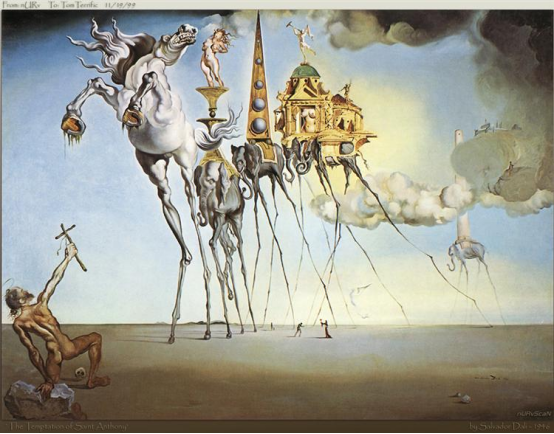
The Temptation of Saint Anthony: Camels and the Illusion of Desire
Salvador Dalí’s The Temptation of Saint Anthony represents a pinnacle of surrealist narrative, utilizing distorted anatomy to depict the psychological burden of spiritual struggle. The painting centers on the figure of Saint Anthony, who is shown clutching a cross to ward off a procession of spindly-legged beasts.
Symbolism of the Spindly Procession
The camels and horses in the composition are characterized by disproportionately long, fragile legs. This technique creates a sense of imminent collapse, symbolizing the precarious nature of human desire and the fragility of physical reality when confronted with the divine.
- The Burden of Wealth: The gold chalice atop the lead elephant represents the temptation of material riches.
- Spiritual Vulnerability: The miniature figure of the Saint serves as a focal point of resistance against the overwhelming scale of the parade.

Mirror Game of Dreams: Appreciation of Dalí’s Elephant Reflected by a Swan
In Swans Reflecting Elephants, Dalí employs the technique of double imagery to manipulate the viewer’s perception. By using the still surface of a pond, the artist transforms the graceful neck of a swan into the trunk of a massive pachyderm, blurring the line between reality and hallucination.
The Paranoiac-Critical Method
Dalí’s signature approach, the Paranoiac-Critical Method, is fully realized here. He forces the viewer to reconcile two distinct images within the same visual space, effectively demonstrating how the subconscious mind projects meaning onto ambiguous forms.
- Visual Duality: The reflection in the water functions as an independent entity, creating a symmetrical narrative.
- Environmental Integration: The desolate, autumnal landscape provides a stark contrast to the fluid, organic shapes of the animals.

Melting Moment: Technical Deconstruction of Dalí’s The Persistence of Memory
The Persistence of Memory remains the most recognizable work of the surrealist movement. Its depiction of soft, melting watches serves as a direct critique of the rigidity of linear time and the predictability of the material world.
Technical Elements of Distortion
The technical brilliance of the piece lies in the hyper-realistic rendering of impossible objects. By treating the melting watches with the same precision as solid metal, Dalí creates a sense of unease that challenges the viewer’s trust in sensory input.
| Feature | Symbolic Meaning |
|---|---|
| Melting Clocks | The fluidity and subjectivity of time. |
| Dead Tree | The decay of the physical realm. |
| Ants | The inevitable process of decomposition. |
The Legacy of Surrealist Iconography
Dalí’s influence extends beyond individual paintings; his work effectively mapped the terrain of the human subconscious. By synthesizing dream logic with classical painting techniques, he provided a visual language for the intangible aspects of the human experience.
Frequently Asked Questions (FAQ)
- Q1: What is the primary meaning behind the melting watches in Dalí’s work?
- The melting watches represent the rejection of time as a rigid, mechanical construct, suggesting instead that time is fluid and relative to the human experience of memory.
- Q2: How did Dalí use the paranoiac-critical method in his paintings?
- This method involved the spontaneous creation of irrational knowledge, allowing Dalí to see multiple images within a single form—a technique seen clearly in the swan-elephant transformation.
- Q3: Why are the animals in The Temptation of Saint Anthony depicted with such long legs?
- The elongated, spindly legs represent the inherent fragility and instability of worldly temptations, emphasizing how easily material desires can collapse under spiritual scrutiny.
- Q4: Is the landscape in Dalí’s paintings based on real locations?
- Yes, Dalí often drew inspiration from the rocky, desolate coastlines of his home in Cadaqués, Catalonia, which provided the backdrop for his surrealist dreamscapes.