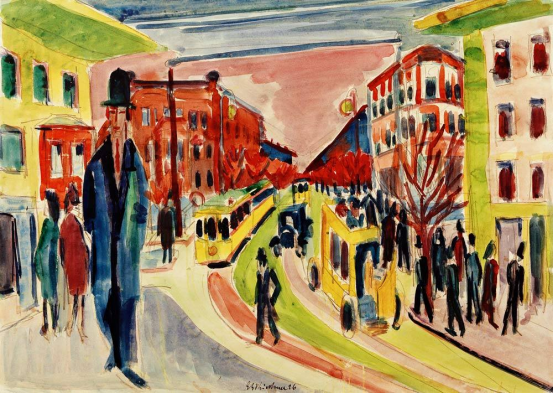
Ernst Ludwig Kirchner, a pivotal figure in German Expressionism and a founding member of the Die Brücke group, extended his radical artistic vision far beyond the canvas. His forays into stage design and performance art represented a profound quest for a “Gesamtkunstwerk”—a total work of art—where painting, sculpture, and performance merged into a singular, immersive experience. This guide delves into Kirchner’s revolutionary approach to the stage, exploring how his “installation-based dream performances” challenged theatrical conventions and left an indelible mark on modern art and performance. We will uncover the historical context that fueled his avant-garde experiments, deconstruct the aesthetic principles that defined his unique vision, and analyze the lasting legacy of his often-unrealized but deeply influential theatrical concepts.
The Genesis of Expressionist Stagecraft: Kirchner and Die Brücke
The early 20th century in Germany was a period of intense social, political, and cultural upheaval, providing fertile ground for artistic experimentation. It was within this tumultuous environment that Ernst Ludwig Kirchner, along with fellow artists Erich Heckel, Karl Schmidt-Rottluff, and Fritz Bleyl, founded Die Brücke (The Bridge) in Dresden in 1905. The group’s name symbolized their ambition to bridge the gap between traditional art and a new, more emotionally direct future. They rejected academic conventions, sought authenticity in raw expression, and found inspiration in primitive art and folk traditions.
The Why: A Quest for Immersive Experience and Total Art
For Kirchner and his peers, painting alone was not enough to capture the full spectrum of human experience and emotion they wished to convey. The traditional proscenium arch stage, with its clear separation between audience and performers, felt restrictive. They yearned for a more immediate, visceral, and all-encompassing artistic statement. Theater, with its potential to combine visual art, movement, sound, and narrative, offered an ideal medium for their “Gesamtkunstwerk” aspirations. This desire to break down boundaries between art forms and create an immersive environment was a driving force behind Kirchner’s theatrical ventures, reflecting a broader modernist impulse to integrate art into life.
Early Influences and Artistic Evolution
Kirchner’s journey into stage design was a natural extension of his evolving artistic practice. His early works already displayed a strong sense of spatial distortion and a vibrant, non-naturalistic color palette, elements perfectly suited for the dramatic demands of the stage. He experimented with various media, including woodcuts and sculpture, which informed his understanding of form and texture – crucial components for creating three-dimensional stage environments and distinctive costumes. His deep engagement with the human figure, often depicted with angularity and psychological intensity, translated seamlessly into his designs for actors and their movements within the theatrical space.

Deconstructing Kirchner’s Vision: The “Dream Performance” Aesthetic
Kirchner’s stage designs were not mere backdrops; they were integral components of a “dream performance” aesthetic, designed to transport the audience into a psychological landscape rather than a literal one. This aesthetic was characterized by a deliberate departure from realism, embracing distortion, vibrant symbolism, and a profound connection to the subconscious.
Characteristics of a Kirchnerian Dream Stage
- Distortion and Exaggeration: Figures and settings were often elongated, angular, and disproportionate, reflecting inner turmoil or heightened emotion rather than objective reality. This distortion aimed to evoke a direct emotional response.
- Vibrant and Symbolic Colors: Kirchner employed a bold, non-naturalistic color palette. Hues were chosen for their emotional impact and symbolic meaning, contributing to the dreamlike, often unsettling atmosphere. Red might signify passion or danger, blue melancholy, and yellow anxiety.
- Psychological Landscapes: The stage became a projection of inner states. Scenery was stripped of superfluous detail, focusing on essential forms that mirrored the emotional core of the narrative or character.
- Influence of Primitivism: Kirchner, like many Die Brücke artists, was deeply influenced by African and Oceanic art. This influence manifested in simplified, mask-like faces, stark figures, and a raw, unrefined energy that imbued his stage characters and settings with an archaic, ritualistic power, further enhancing the dreamlike, archetypal quality.
In-depth Analysis: The “Dream Performance” as Modernist Innovation
The concept of “dream performance” in early modernism was a radical departure from the naturalistic theater prevalent in the late 19th century. Influenced by nascent psychoanalytic theories, particularly those of Sigmund Freud, artists like Kirchner sought to explore the subconscious, dreams, and the irrational aspects of human experience. His stage designs aimed to visualize these internal worlds, making the hidden psychological drama manifest. The “dream performance” was not about telling a linear story but about creating an experience that resonated on a deeper, pre-verbal level, challenging the audience to confront their own subjective interpretations and emotional responses. This approach paved the way for future avant-garde theatrical movements that prioritized atmosphere and psychological depth over narrative realism.
Beyond the Canvas: Installation-Based Environments
Kirchner’s revolutionary approach to the stage went beyond simply painting scenery; he conceived of the entire theatrical space as an immersive, “installation-based” environment. This meant that costumes, props, lighting, and even the implied soundscape were designed to contribute to a unified artistic experience, blurring the lines between visual art and performance.
Creating Immersive “Installations” on Stage
Unlike traditional theater, which often relied on painted backdrops to suggest a location, Kirchner envisioned a stage where every element was a sculptural or painterly component of a larger, three-dimensional artwork. His designs treated the stage as a canvas to be inhabited, with actors moving within and interacting with the art itself. Costumes were not mere garments but extensions of the characters’ psychological states, often angular and brightly colored, distorting the human form to match the distorted sets. Props were simplified, symbolic objects, imbued with heightened meaning through their placement and interaction with the performers.
The Role of the Performer in Kirchner’s Environments
In these installation-based settings, the performer became a living, moving sculpture. Their gestures, movements, and even their stillness were choreographed to harmonize with the visual environment. The actor was not merely enacting a role but embodying a visual element, contributing to the overall aesthetic impact. This demanded a new kind of theatricality, one that prioritized symbolic movement and emotional expression over realistic portrayal, turning the stage into a dynamic tableau vivant.
Detailed Procedure: Imagining Kirchner’s Design Process
While specific detailed procedures for Kirchner’s stage productions are scarce, we can infer his likely design process based on his artistic philosophy and known works:
- Conceptualization of Emotional Core: Kirchner would likely begin by identifying the core emotional or psychological themes of the play or performance. This would dictate the overall mood and visual language.
- Sketching Dynamic Forms: He would then create numerous sketches, often woodcuts or drawings, focusing on the angularity, distortion, and expressive potential of both figures and architectural elements.
- Color Palette Selection: A symbolic color palette would be chosen to amplify the desired emotions, with colors often clashing or vibrating to create tension.
- Three-Dimensional Model Building: For truly “installation-based” designs, Kirchner might have created small-scale models or maquettes, experimenting with spatial relationships, light, and shadow.
- Costume and Prop Integration: Costumes would be designed in tandem with the sets, ensuring visual coherence and enhancing the performers’ sculptural presence. Props would be minimal but highly symbolic.
- Lighting as Emotional Tool: Although perhaps less documented, Kirchner would have likely considered how lighting could further distort forms, create dramatic shadows, and intensify the emotional impact, much like a painter uses chiaroscuro.
Techniques and Materials: Crafting the Expressionist Stage
Kirchner’s approach to stage design was deeply rooted in his broader artistic techniques, particularly his mastery of woodcuts and his distinctive use of color and form. These elements were not merely decorative but fundamental to conveying the raw, emotional intensity of Expressionism within the theatrical space.
Woodcuts and Bold Lines: Defining Form
The woodcut, a medium Kirchner passionately embraced, significantly influenced his stage aesthetic. The strong, angular lines, simplified forms, and stark contrasts inherent in woodcut printing translated directly into his designs. On stage, this meant:
- Simplified Forms: Scenery and props were often reduced to their essential, almost abstract, shapes. This simplification allowed for powerful, immediate visual impact.
- Bold Outlines: Much like the thick lines of a woodcut, elements on stage might have been defined by strong, dark outlines, enhancing their dramatic presence and contributing to a sense of tension or dynamism.
- Dynamic Composition: The energetic, often jagged compositions characteristic of his graphic work found their equivalent in the arrangement of stage elements, creating visually arresting and emotionally charged scenes.
Color Palette: Symbolic and Non-Naturalistic
Kirchner’s use of color on stage was never about verisimilitude. Instead, he employed a non-naturalistic, highly symbolic palette to evoke specific emotions and psychological states.
- Intense Hues: Bright, often clashing colors were used to create a sense of unease, excitement, or spiritual intensity.
- Emotional Resonance: Colors were chosen for their psychological impact rather than their descriptive accuracy. A character’s costume might be a jarring red to signify passion or anger, or a melancholic blue for despair.
- Flat Areas of Color: Similar to his paintings, large, flat areas of unmodulated color could be used to define planes and create a sense of flatness or artificiality, further distancing the performance from everyday reality.
Scale and Perspective: Deliberate Distortions
To heighten emotional effect and contribute to the dreamlike quality, Kirchner manipulated scale and perspective.
- Exaggerated Proportions: Objects or figures might be rendered disproportionately large or small to emphasize their symbolic importance or to create a sense of claustrophobia or grandeur.
- Skewed Perspectives: Rather than using conventional linear perspective, Kirchner often employed multiple or distorted perspectives, creating an unsettling, disorienting spatial experience for the audience, mirroring the fragmented reality of the subconscious.
Technical Checklist: Elements of an Expressionist Stage Design
- Angular, simplified architectural forms
- Non-naturalistic, symbolic color palette
- Distorted human figures and costumes
- Bold, graphic lines and contrasts
- Heightened emotional atmosphere
- Minimalist, yet symbolically potent, props
- Focus on psychological rather than realistic setting
The Legacy and Influence of Kirchner’s Stage Theater
Although many of Kirchner’s stage designs remained conceptual or were realized only in limited productions, their influence reverberated through the 20th century, profoundly impacting subsequent theatrical movements and solidifying his place as a visionary in the realm of performance art.
Impact on Modern Theater Design
Kirchner’s radical departure from naturalism paved the way for other avant-garde theater designers. His emphasis on psychological landscapes, symbolic color, and the integration of fine art into performance prefigured developments in:
- Bauhaus Theater: Artists like Oskar Schlemmer at the Bauhaus further explored the abstract, geometric, and sculptural potential of stage design, treating the human body as a form within a larger artistic composition.
- Epic Theater: Bertolt Brecht’s Epic Theater, while distinct in its political aims, shared Kirchner’s rejection of immersive realism, opting instead for a more stylized, often didactic, presentation that highlighted the constructed nature of performance.
- Expressionist Film: The visual language of German Expressionist cinema (e.g., The Cabinet of Dr. Caligari) directly mirrored Kirchner’s stage aesthetic, with its distorted sets, stark lighting, and exaggerated acting styles.
Contribution to the “Gesamtkunstwerk” Ideal
Kirchner’s stage theater stands as a powerful testament to the “Gesamtkunstwerk” ideal, demonstrating how diverse art forms could coalesce into a unified, potent statement. His work championed the idea that painting, sculpture, architecture, and performance were not disparate disciplines but interconnected expressions of a single artistic impulse. This holistic vision continues to inspire contemporary artists seeking to create multi-sensory and immersive experiences.
Relevance in Contemporary Performance Art
The spirit of Kirchner’s “installation-based dream performances” finds echoes in today’s performance art and immersive theater. Contemporary artists often create environments where the audience is no longer a passive observer but an active participant, and where the boundaries between art and life are deliberately blurred. His pioneering efforts to create psychologically charged, visually dominant theatrical spaces remain a touchstone for those pushing the boundaries of what performance can be.
Pro Tips: Interpreting Expressionist Stage Designs Today
- Look Beyond Narrative: Focus on the emotional and psychological impact rather than a literal story.
- Analyze Color Symbolism: Consider what the non-naturalistic colors might represent emotionally or symbolically.
- Identify Distortion’s Purpose: Ask why forms are distorted – is it for tension, unease, or to convey an inner state?
- Consider the Actor’s Role: How do the performers interact with and become part of the visual environment? Are they figures or living sculptures?
- Contextualize Historically: Remember the social and political turmoil of early 20th-century Germany that fueled this art.
Kirchner’s Stage Design: A Comparative Overview
To fully appreciate Kirchner’s revolutionary approach, it’s helpful to compare his stage design philosophy with both traditional 19th-century theater and other modernist movements.
| Feature | 19th Century Realism/Naturalism | Kirchner’s Expressionist Stage | Other Modernist Approaches (e.g., Futurism) |
|---|---|---|---|
| Goal | Illusion of reality, moral instruction, entertainment | Emotional expression, psychological immersion, Gesamtkunstwerk | Dynamic energy, machine aesthetic, breaking tradition |
| Scenery | Detailed, historically accurate, painted backdrops | Distorted, symbolic, angular, “installation-based” environments | Abstract, geometric, industrial, often kinetic |
| Color | Naturalistic, subdued, realistic tones | Non-naturalistic, vibrant, symbolic, clashing hues | Bold, primary colors, often representing speed/power |
| Performer Role | Realistic portrayal of character, dialogue-driven | Living sculpture, embodying emotion, integrated with visual art | Machine-like, dynamic movement, often provocateur |
| Audience Experience | Passive observation, emotional identification with characters | Active interpretation, psychological resonance, confronting inner states | Shock, engagement through noise/movement, breaking conventions |
| Key Influences | Historical accuracy, literature, social commentary | Primitivism, psychoanalysis, Die Brücke philosophy | Industrialization, speed, war, technology |
Frequently Asked Questions (FAQ)
- What is a “Gesamtkunstwerk” in the context of Kirchner’s stage designs?
- A “Gesamtkunstwerk” translates to “total work of art.” For Kirchner, it meant the ambitious integration of all art forms—painting, sculpture, architecture, music (implied), and performance—into a single, unified, and immersive artistic experience on the stage. He sought to break down the traditional hierarchies and boundaries between these disciplines to create a more profound and holistic artistic statement.
- How did Kirchner’s stage designs differ from traditional theater of his time?
- Traditional theater of Kirchner’s era often aimed for naturalism, with realistic sets and costumes designed to create an illusion of reality. Kirchner, conversely, embraced distortion, non-naturalistic colors, and symbolic forms. His stages were not meant to mimic reality but to create psychological landscapes that expressed inner emotions and subconscious states, functioning more as immersive art installations than conventional backdrops.
- What role did Primitivism play in Kirchner’s stage aesthetic?
- Primitivism, an admiration for and appropriation of non-Western art forms (particularly African and Oceanic), deeply influenced Kirchner. On his stage, this manifested in simplified, mask-like faces for characters, angular and raw figures, and a powerful, almost ritualistic energy in the sets and movements. This influence helped him to strip away academic conventions and achieve a more direct, primal emotional expression, contributing to the dreamlike and archetypal quality of his performances.
- Were Kirchner’s stage designs ever fully realized?
- Many of Kirchner’s stage designs remained conceptual or were realized only in limited capacity, often in private performances or as sketches and models. He faced challenges in finding theaters willing to embrace his radical vision, and the practicalities of translating his Expressionist aesthetic to a full-scale production were significant. However, his theoretical contributions and visual ideas were highly influential, inspiring subsequent generations of artists and designers.
- How does Kirchner’s “dream performance” concept relate to modern immersive theater?
- Kirchner’s “dream performance” concept, with its emphasis on psychological immersion, symbolic environments, and blurring the lines between art forms, can be seen as a precursor to modern immersive theater. Both seek to transcend passive observation, creating environments where the audience is enveloped in the artistic experience and where subjective interpretation is paramount. His vision of the stage as an installation, rather than just a setting, directly resonates with contemporary performance art that creates multi-sensory, interactive spaces.