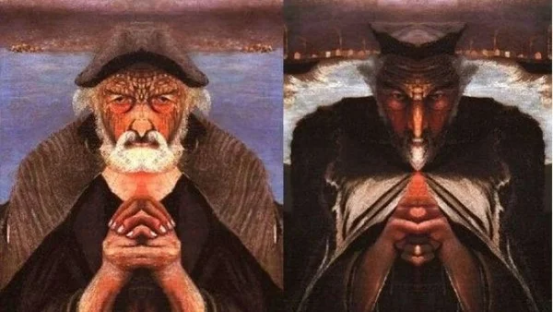
Throughout the vast history of art, certain paintings, like mysterious realms shrouded in thick fog, captivate countless viewers. They not only captivate with their visual impact, but also sow endless curiosity and questions within the viewer through obscure symbols, ambiguous narratives, and hidden details. These enigmatic paintings transcend the boundaries of time and space. From the elusive smile painted by Leonardo da Vinci to the grotesque dreamworlds on Bosch’s canvases to the silent street graffiti of Banksy, they are like lockboxes waiting to be unlocked, tempting us to explore the truth within, but the moment the mystery is revealed, it always leaves more suspense. Their allure lies far more than just visual shock, but also in the eternal “unfinished” blank space – allowing each generation to find their own interpretation within, truly making art a dialogue that spans centuries.
1. Hidden Symbols of the Renaissance: The Puzzles of Light and Shadow in Leonardo da Vinci and Caravaggio
Renaissance artists seem particularly adept at captivating audiences through a sense of restrained mystery. Leonardo da Vinci’s Mona Lisa undoubtedly exemplifies this trend. Created in the early 16th century, the portrait now hangs in a climate-controlled glass enclosure in the Louvre, drawing tens of thousands of visitors daily. People gaze not only at the face of the Florentine noblewoman, but also at her expression, a half-smile. Leonardo da Vinci skillfully employed the technique of sfumato, blurring the corners of Mona Lisa’s mouth and eyes with the transition between light and shadow, creating neither a clear outline nor a distinct emotional expression. When you look directly into her eyes, she appears to be smiling; but when you shift your gaze to her hands, the smile suddenly vanishes, leaving you stunned.
Even more captivating is the mystery surrounding the painting’s identity. For years, scholars have debated the question: “Who is Mona Lisa?” Some believe she is Lisa Gioconda, wife of the wealthy merchant Giocondo; others speculate that it’s a self-portrait of Leonardo da Vinci (through gender reassignment); and some even suggest she embodies “ideal beauty” by combining multiple female features. The painting’s background is also fraught with doubt—the horizon on the left is lower than the right, and the landscapes on each side appear to be from different times and places. Why did Leonardo da Vinci design this way? Was it a metaphor for the character’s inner conflict, or perhaps a reflection on his profound thoughts on the order of the universe? These questions transform the Mona Lisa into more than just a portrait, but a never-ending mystery novel.
Unlike Leonardo da Vinci’s soft mystery, Caravaggio employed light and shadow to create poignant suspense. This late 16th-century painter mastered the technique of chiaroscuro, employing intense contrasts of light and shadow to divide the painting into visible and hidden parts, allowing the viewer to capture fragments of the story within these interplays of light and shadow. Take “Judith Beheading Holofernes,” for example: in the center, Judith clutches her dagger, the bloodstains on the blade clearly visible in the light; Holofernes’s distorted face, shrouded in shadow, its expression of agony barely visible. In the darkness of the background, only the maid’s eyes glow faintly, as if witnessing an unspeakable secret. Caravaggio deliberately concealed certain details, not for omission, but to encourage the viewer to actively “fill in” the story’s blanks: Why is Judith so resolute? Is there fear or determination in the maid’s eyes? This “unclear mystery” imbues the static painting with dynamic narrative tension, making every viewer a participant in the story.
2. Fantasy and Absurdity: The Surreal Dreams of Bosch and Dali
If the mystery of the Renaissance is a “restrained metaphor”, then Bosch’s “This Earthly Garden” in the 15th century and Dali’s “The Persistence of Memory” in the 20th century incorporated “absurdity” and “fantasy” into the canvas, creating a mysterious world beyond the logic of reality.
Bosch’s “This Earthly Paradise” is a triptych. The left panel depicts Adam and Eve in the Garden of Eden, the center panel showcases “Human Revelry and Desire,” and the right panel depicts “The Punishment and Suffering of Hell.” However, the elements within the painting radically break with the conventions of religious painting: in the center panel, people dance with giant fruits and bizarre birds and beasts, some ride on the backs of half-human, half-fish creatures, and others dance around transparent egg-shaped objects. In the right panel, in Hell, piano-shaped torture instruments torture humans, and demons devour bird-headed figures. These absurd images resemble neither biblical stories nor the real world, but more like a mad dream. Art historians have debated Bosch’s intentions for centuries: Was he criticizing the depravity of human desire or depicting symbolic images from medieval folklore? These mysteries remain unresolved, and Bosch’s “This Earthly Paradise” remains an unanswered puzzle, each examination revealing new details and sparking new speculation.
Unlike Bosch’s absurdity, Dalí brought this “dreamlike mystery” into the modern era. His “The Persistence of Memory,” created in 1931, depicts a soft clock, like melted wax, hanging from bare branches, resting on misshapen rocks, and even covering the face of a sleeping figure. The background is a desolate coastline, the sky pale and cloudless, and the entire painting exudes an eerie tranquility. Dalí once said that the painting was inspired by a dream: “I saw a piece of melting cheese, and it suddenly occurred to me that a clock could be soft.” This seemingly random inspiration conceals a profound meditation on time: Does the soft clock hint at the subjectivity of time? Does the sleeping face represent humanity’s numbness to the passage of time? Dalí never directly explained his works, believing that “mystery is the soul of art” and that once the mystery is revealed, the work’s charm disappears. This deliberate blankness has made “The Persistence of Memory” a classic of Surrealism, allowing each viewer to find their own “metaphor of time” within it.
3. Streets and Anonymity: Banksy and Magritte’s “Everyday Puzzles”
Mysterious paintings aren’t just found in museums; they’re also hidden on the streets and in ordinary scenes of life. Banksy is one of the most famous contemporary “mysterious artists”—his true identity remains unknown. His works often appear unexpectedly in London alleys, New York subways, or on the Palestinian separation wall, carrying sharp irony and warm empathy, but never leaving a signature.
One of Banksy’s most famous works is “Girl with Balloon”: it depicts a young girl reaching for a floating balloon, which threatens to slip from her grasp. Originally painted in a London alley, the painting was later made into a print and sold at auction. In 2018, at the moment the auctioneer’s hammer fell, a shredder Banksy had pre-installed within the frame activated, shredding the painting into fragments, transforming into his new work, “Love in the Trash.” This act itself is shrouded in mystery and rebellion: is he mocking the commercialization of the art market, or expressing the theme of the transience of beauty? No one can definitively answer, but this “accidental” and “anonymous” nature elevates Banksy’s work beyond the realm of street art, becoming a silent interrogation of contemporary society.
Belgian painter René Magritte excelled at creating mystery within everyday scenes. In his “Man with a Black Hat” (also known as “Son of Man”), a man in a suit and a top hat stands by the sea, a giant apple hovering in front of him, completely obscuring his face. This seemingly ordinary scene is rife with contradictions: Why is the apple floating? Why is the man covering his face? Magritte once said, “I want to create an image that confuses people, because confusion provokes reflection.” He believed that the “defamiliarization” of everyday objects is the ultimate mystery. When the familiar apple, suit, and sea are combined into an illogical image, we realize how superficial our understanding of the “everyday” actually is. This ability to “unearth mystery from the ordinary” makes Magritte’s works a mirror, revealing our own blind spots.
4. The Nature of Mystery: Why are we fascinated by unsolved mysteries?
From the Renaissance to the present day, mysterious paintings have captivated us across time and space because they appeal to our innate curiosity about the unknown. In today’s information-rich world, we’re accustomed to quick answers, using search engines to resolve all our questions. Yet, mysterious paintings simply refuse to answer. They don’t explain the meaning of symbols, reveal the ending of a story, or even reveal the artist’s identity. This resistance only deepens our fascination.
More importantly, enigmatic paintings transform art from a one-way appreciation into a two-way interaction. When we stand before the Mona Lisa and speculate on her smile, search for hidden symbols in The Garden of Earthly Delights, or debate Banksy’s anonymity, we are no longer passive spectators but active puzzle solvers. Each interpretation is a process of infusing the painting with our own experiences, reflections, and emotions, and a dialogue across time and space with the artist and other viewers. As Magritte said, “The meaning of art lies not in the answer itself, but in the process of finding the answer.”
These enigmatic paintings ultimately become cultural “living fossils.” Unconfined by a single era, they gain new life through the interpretations of each generation. Leonardo da Vinci’s smile, Bosch’s fantasies, Dalí’s soft clocks, Banksy’s street graffiti—these seemingly isolated mysteries actually speak to a common truth: truly great art never provides answers, but rather inspires us to perpetually ask questions—because in the process of asking questions, we explore not only the mysteries of art but also the vast world within ourselves.
When we gaze once again upon these enigmatic canvases, perhaps we need not obsess over finding the “single truth.” After all, the allure of mystery lies in its ability to allow everyone to see their own unique landscape within it, turning a single painting into countless unfinished stories.