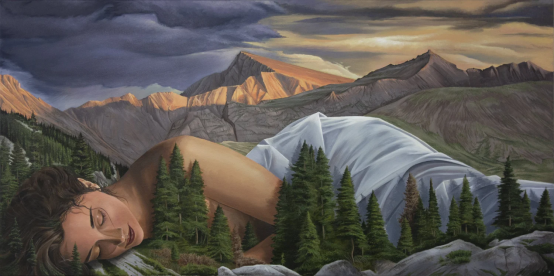
Every sunset is nature’s gentle farewell—the sun’s final rays gradually fade into the horizon, the sky quietly shifting colors, from orange-red to pink-purple, from golden amber to the deep blue of night. Each sunset instantly unfolds nature’s most beautiful canvas. This shift from scorching heat to gentle warmth has inspired countless artists, making sunset paintings a unique landscape in art history. Artists not only recreate the sunset scene but also seek to capture the emotion of that moment—a dialogue between colors, a resonance between emotion and nature.
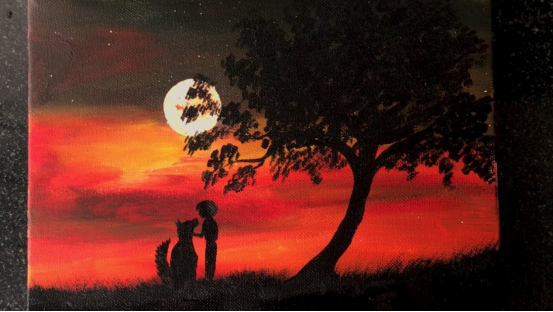
1. Color and Emotion: Sunset as a Palette on Canvas
The allure of a sunset often lies in its ever-changing colors. From fiery orange to gentle purple to deep indigo, each hue carries a distinct emotion. Artists freely explore these fleeting interplays of light and shadow. For many artists, the colors of a sunset are more than just a display of nature; they are a reflection of emotion.
The French Impressionist master Claude Monet is undoubtedly one of the artists who best captured the light and shadow of sunset. In his painting “Rouen Cathedral, Sunset,” the stone walls of the cathedral are not precisely outlined, but rather the warmth of the setting sun is conveyed through blocks of color. The setting sun paints the entire building a soft orange, while the surrounding scenery becomes increasingly blurred in the afterglow. Monet’s unique skill lies in his focus on capturing the dynamics of light rather than the scenery itself. He once said, “I only paint the light as I see it.” And this light is not only a visual representation, but also an emotional flow.
Unlike Monet, Van Gogh transformed the colors of sunset into an outburst of emotion. Although his masterpiece, “The Starry Night,” depicts the night sky, the colors of sunset permeate it. The collision of orange and indigo elicits a surging fervor. He once wrote in a letter, “The sky at sunset is so fiery that I must chase it with the most intense colors.” For him, sunset was not only a natural display of color but also a manifestation of inner emotion. His works, with their powerful brushstrokes and blocks of color, express the passion of life, and color became the language of his inner world.
2. The Story of Light and Shadow: The Poetry of Light and Dark at Sunset
Sunsets are not only a fantasy of color but also a subtle play of light and shadow. When the sun is low in the sky, its soft light casts long shadows, imbuing every silhouette with a warm golden edge. It’s this low-angle light that creates the stark contrast between light and dark, a technique artists use to express emotion.
For example, in “Beach at Dusk,” the American painter Winslow Homer uses light and shadow to create a scene of waiting. Two women stand quietly on the beach, their shadows lengthened by the setting sun, and the dampness of the sand seems to breathe in the warmth of the twilight. The seawater is dyed amber, while the returning boats in the distance are only black silhouettes. In this work, the interweaving of light and shadow not only shapes the landscape but also imbues the image with a sense of waiting and loss. The gradually darkening horizon seems to tell the viewer that time is silently passing.
French painter Jean-Baptiste-Camille Corot’s “Roman Forum Sunset” similarly harnesses the power of light and shadow to imbue ancient ruins with new life. The setting sun paints the Roman ruins a golden hue, while the shadows of the stone columns interweave into geometric patterns, evoking a sense of the depth and depth of history. Unlike Homer’s work, Corot’s work possesses a more tranquil quality. Through delicate light and shadow, he conveys the gentleness and contemplation of sunset, conveying a sense of “time standing still.”
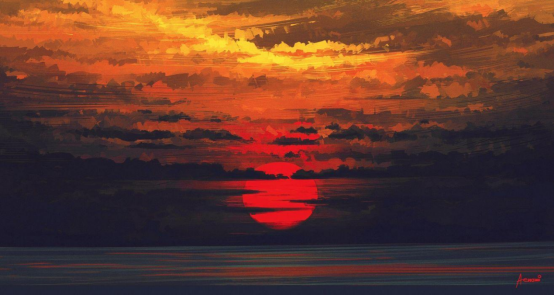
3. Emotional Sustenance: Metaphors and Reflections in Sunset
Sunset is not only the end of time, it is also a symbol of emotion. For many artists, sunset is a metaphor for the transience of life and the passage of time, an expression of emotions closely linked to separation, longing and hope.
For example, in his sunset sketch of “Foolish Old Man Who Moved Mountains,” the modern Chinese painter Xu Beihong used the setting sun as a symbol of hope. The old man and his descendants continue to toil along the mountain path, illuminated by the setting sun’s rays, symbolizing that even in difficult times, the power of hope shines. This work breaks with the traditional notion of sunset as an end, imbuing it with new meaning—no longer a cessation, but the beginning of a new wave of hope.
Norwegian painter Edvard Munch’s “Anxiety at Sunset” uses the sunset to express inner unease. In the painting, the sky distorts into hues of orange-red and inky blue, like a swirling, all-consuming vortex. The distorted figures and blurred cityscape create a sense of anxiety and fear about the passage of time. In Munch’s painting, sunset is no longer a natural beauty, but a magnified emotion, a manifestation of humanity’s fear of impermanence and its questioning of existence.
4. The charm of sunset paintings: Why are we fascinated by sunsets?
Why are artists so captivated by sunsets? Perhaps it’s because they possess a unique “fascination of contradictions”—they are both an “end” and a “beginning,” fleeting yet endless, a natural beauty and a concentrated expression of human emotion. For us in modern society, sunset is more than just the end of the day; it reminds us how much we need to cherish and appreciate within our limited time.
In this fast-paced world, we often lack the time to pause and carefully observe a sunset. Sunset paintings offer us the opportunity to pause and re-perceive the world. Each sunset painting is a letter to time, allowing us to rediscover those beautiful moments we once overlooked amidst our busy lives. These paintings build a bridge between nature and human emotion, allowing us to rediscover warmth and strength through visual experience.
When the sunset sinks into the sky again, artists are still obsessed with capturing the beauty of this moment, because they know that sunset is not only a change in nature, it is also an emotion that touches the soul, connecting everyone’s memories and emotions.