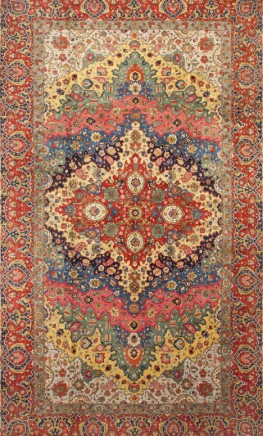
I recently did some in-depth research on Persian rug craftsmanship and I can’t wait to share the secrets with you.
Historical Origins
The history of Persian carpets can be traced back thousands of years. There is evidence that carpet weaving technology has appeared in Persia as early as the 5th century BC. In ancient times, carpets were not only a practical household item for the Persians, but also a symbol of wealth, status and culture. They were often used to decorate palaces, temples and nobles’ mansions.
In the 16th century, with the rise of the Safavid dynasty, Persian carpet craftsmanship ushered in a golden age. The rulers at that time strongly supported the carpet manufacturing industry and established many royal carpet factories. In cities such as Isfahan, a large number of skilled craftsmen gathered, who constantly innovated and improved the carpet making process, making the quality and artistic value of Persian carpets reach unprecedented heights. Persian carpets of this period, with their exquisite patterns, rich colors and excellent craftsmanship, were sold well throughout Europe and Asia, becoming an important commodity in international trade at that time.
After years of baptism, the Persian carpet craft has been passed down from generation to generation, and even under the impact of modern industrialization, it still maintains a strong vitality. Today, Iran (the successor of ancient Persia) is still the main producer of Persian carpets. Many family workshops and small factories continue the ancient traditional craftsmanship and pass on the artistic charm of Persian carpets to the world.
Production process
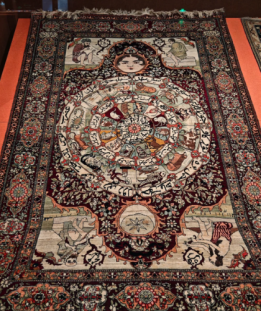
The quality of Persian carpets depends first on the choice of raw materials. Traditional Persian carpets are mainly made of wool, silk and cotton thread. Among them, wool is mostly made from high-quality Iranian sheep. This kind of wool fiber is delicate, soft and elastic, which can bring good texture and warmth to the carpet.
Silk adds luxury and luster to the carpet. High-quality Persian silk carpets are made of carefully selected mulberry silk, which is light and smooth, making the carpet reach the extreme in touch and visual effect. Cotton thread is usually used for the warp of the carpet to provide stable support for the entire woven structure.
There are two main weaving techniques for Persian carpets: Persian knot (also known as asymmetrical knot) and Turkish knot (symmetrical knot). Persian knot is the most representative weaving method for Persian carpets. Its characteristic is that the yarn is wound around two adjacent warps and then the thread ends are pulled out from another warp. This weaving method makes the carpet surface tighter and smoother, and the pattern is more delicate and clear. The Turkish knot is that the yarn is wound around two adjacent warps twice, and then the thread ends are pulled out from between the two threads. Relatively speaking, this knotting method is faster to weave, but the compactness of the carpet surface and the delicacy of the pattern are slightly inferior.
Persian carpets enjoy a high reputation worldwide for their excellent craftsmanship and unique artistic charm. In the West, Persian carpets are regarded as “art on the ground” and are favored by royal families, wealthy people and art collectors. Many famous palaces, mansions and art museums are proud to collect exquisite Persian carpets, such as Buckingham Palace in the UK and Versailles Palace in France, which display precious Persian carpets. They not only add a luxurious atmosphere to these buildings, but also witness art and history.