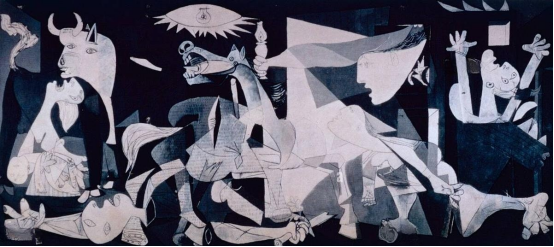
Pablo Picasso’s Guernica is not merely a painting; it is a monumental testament to the horrors of war and a powerful symbol of peace. Created in 1937, this massive mural-sized canvas captures the anguish and chaos of a specific historical event, yet its message transcends time and place. Through a stark, monochromatic palette and a complex web of surrealist and cubist imagery, Picasso crafted a visual scream that continues to resonate with audiences worldwide. This guide will provide a deep dive into the historical catalyst for the painting, deconstruct its intricate symbolism, and explore the artistic genius that makes Guernica one of the most important works of the 20th century.
The Historical Catalyst: The Bombing of Guernica
To understand the painting, one must first understand the event that inspired it. On April 26, 1937, during the Spanish Civil War, the Basque town of Guernica was subjected to a brutal aerial bombing. The attack was carried out by Nazi Germany’s Condor Legion at the request of Spanish Nationalist leader Francisco Franco. It was one of the first instances of a civilian population being targeted by a saturation bombing campaign, a terrifying new tactic of modern warfare. The bombing was a calculated act of terror designed to crush morale. Picasso, then living in Paris, was horrified by the news reports and photographs of the devastation. This singular event galvanized him, transforming his commission for the Spanish Pavilion at the 1937 Paris International Exposition from an abstract theme into a direct, furious response to the atrocity.
Deconstructing the Canvas: A Guide to Guernica’s Symbols
Guernica is a dense tapestry of figures and symbols, each contributing to the overall narrative of suffering and chaos. While Picasso was famously reluctant to assign fixed meanings to his imagery, art historians have identified several key elements that anchor the composition. The scene is a chaotic interior, suggesting a bombed-out building, where humans and animals are trapped in a moment of extreme agony.
The Bull and the Horse
The two most dominant animal figures are the bull on the left and the screaming horse in the center. The bull, a potent symbol in Spanish culture, is often interpreted as representing brutality, darkness, or even Franco’s fascism. However, Picasso himself suggested it could also stand for the stoicism and strength of the Spanish people. The horse, contorted in pain with a spear piercing its side, is a more universally accepted symbol of suffering innocence and the agony of the people.
The Human Figures
The painting is filled with human anguish. On the far left, a mother shrieks in grief while clutching her dead child, a timeless image of maternal suffering. To the right, a figure is trapped in a burning building, screaming towards the sky. Another figure rushes in from the right, holding a lamp, perhaps symbolizing a desperate search for truth or hope amidst the darkness. On the ground lies a dismembered soldier, his broken sword still clutched in his hand, from which a single flower grows—a fragile symbol of hope.
The Light Sources
Two sources of light illuminate the scene. A bare, jagged light bulb hangs from the ceiling, often interpreted as the harsh, unfeeling glare of modern technology and warfare. A more hopeful light is offered by the figure with the oil lamp, representing the possibility of truth and conscience bearing witness to the horror.
Artistic Style: The Fusion of Cubism and Surrealism
Picasso’s choice of style is as important as his subject matter. He employed a stark, monochromatic palette of black, white, and shades of grey, which evokes the starkness of newspaper photography and lends the painting a documentary-like urgency. The style is a masterful blend of Cubism and Surrealism.
- Cubism: The fractured, fragmented bodies and the simultaneous depiction of multiple viewpoints are hallmarks of Cubism. This technique shatters the scene, forcing the viewer to experience the chaos and disorientation of the bombing.
- Surrealism: The distorted, dream-like, and emotionally charged figures—like the screaming horse and the bull—tap into the subconscious terror and psychological trauma of the event, which is a key tenet of Surrealism.
Symbolism Interpretation Table
The symbols in Guernica are famously ambiguous. This table presents some of the most common interpretations for its key elements.
| Symbol | Primary Interpretation (Darkness) | Alternative Interpretation (Hope/Strength) |
|---|---|---|
| The Bull | Fascism, brutality, darkness, Franco | The enduring spirit and strength of Spain |
| The Horse | The suffering of innocent people and animals | The agony and sacrifice of the Republican cause |
| The Light Bulb | The harsh, destructive power of modern technology | A “bomb” of light, exposing the horror |
| The Flower | A fragile, almost lost symbol of life | Regeneration and hope emerging from destruction |
A Legacy in Black and White: Guernica’s Global Journey
After its exhibition in Paris, Guernica went on an international tour to raise awareness and funds for the Spanish Republican cause. Picasso stipulated that the painting should not return to Spain until the country was a democratic republic. For decades, it was housed at the Museum of Modern Art (MoMA) in New York, where it became a universal symbol for anti-war movements, particularly during the Vietnam War. Following the death of Franco and the restoration of democracy, the painting was finally returned to Spain in 1981. Today, it resides in the Museo Reina Sofía in Madrid, serving as a permanent, powerful reminder of the devastating consequences of conflict.
Frequently Asked Questions (FAQ)
-
Why is Guernica in black and white?
- Picasso chose a monochromatic palette to evoke the raw, documentary feel of newspaper photographs that first informed him of the bombing. This lack of color removes any distraction, focusing the viewer entirely on the stark forms and the raw emotion of the scene, heightening its dramatic intensity and timelessness.
-
Is Guernica a Cubist or Surrealist painting?
- It is a brilliant synthesis of both. It uses the fragmented perspectives and geometric forms of Cubism to depict the physical chaos of the event. Simultaneously, it employs the distorted, dream-like, and emotionally charged imagery of Surrealism to convey the psychological horror and trauma of war.
-
What is the actual size of Guernica?
- The painting is monumental in scale, measuring approximately 3.49 meters (11 feet 5 inches) tall and 7.76 meters (25 feet 6 inches) wide. Its immense size is designed to envelop the viewer, making the experience of witnessing the scene more immersive and overwhelming.
-
Where is the original Guernica painting today?
- The original Guernica is on permanent display at the Museo Nacional Centro de Arte Reina Sofía in Madrid, Spain. It was returned to Spain in 1981 after a long-term loan to the Museum of Modern Art (MoMA) in New York, fulfilling Picasso’s wish for it to belong to the Spanish people after the restoration of democracy.