Pierre-Auguste Renoir remains one of the most beloved and significant figures of the Impressionist movement. His work is synonymous with a profound celebration of beauty, often found in the simple, unguarded moments of everyday life. Unlike some of his contemporaries who focused on the changing landscapes or the stark realities of urbanization, Renoir turned his brush towards human connection, warmth, and the transient effects of light on figures and their environments. His paintings are vibrant testaments to the joy of being alive, capturing laughter, conversation, and quiet contemplation with equal sensitivity. This comprehensive analysis explores three of his seminal works, each representing a different facet of his artistic genius, to understand how he masterfully blended technique, color, and composition to immortalize fleeting moments of Parisian life.
Bal du moulin de la Galette: A Symphony of Dappled Light and Social Life
Painted in 1876, Bal du moulin de la Galette is arguably one of the most iconic works of Impressionism. It depicts a typical Sunday afternoon at the Moulin de la Galette, an open-air dance hall and courtyard in the heart of Montmartre. This painting is not just a scene; it is an immersive experience, a whirlwind of activity, color, and, most importantly, light. Renoir’s primary achievement here is his revolutionary depiction of dappled sunlight filtering through the acacia trees, dotting the clothing and faces of the dancing and conversing figures with patches of pink and purple light.
The Montmartre Context: Setting the Scene
In the late 19th century, Montmartre was a bustling, bohemian district inhabited by artists, writers, and the working class of Paris. The Moulin de la Galette was a popular social hub where people gathered to relax, dance, and escape the rigors of city life. Renoir, who had a studio nearby, was deeply embedded in this community. He used his friends, models, and local residents as figures in the painting, infusing the scene with a sense of genuine camaraderie and authenticity. This connection to the subject matter allows the viewer to feel like a participant rather than a mere observer of this lively social gathering.
Technical Brilliance: The Play of Light and Shadow
Renoir broke from academic tradition, which dictated that shadows should be rendered in blacks and grays. Instead, he painted shadows with color, particularly blues and purples, reflecting the ambient light and adding vibrancy to the entire composition. The most striking technical aspect is the treatment of sunlight. The flickering spots of light create a powerful sense of movement and immediacy, as if the leaves above are rustling in a gentle breeze. This technique, which initially shocked critics, perfectly captures the ephemeral nature of the moment—a core tenet of the Impressionist philosophy. The loose, fluid brushstrokes further enhance this feeling of motion, blurring the figures and blending them into a cohesive, energetic whole.
A Snapshot of Parisian Leisure: Characters and Atmosphere
The composition is a masterful arrangement of figures that guides the eye through the scene. In the foreground, a group is seated at a table, engaged in conversation, grounding the painting. Beyond them, the dance floor is a swirl of couples, their forms dissolving into a flurry of color and movement. Despite the large number of people, Renoir imbues the scene with individual moments of connection and flirtation. The overall atmosphere is one of carefree joy and vibrant energy, a perfect encapsulation of the joie de vivre that would become a hallmark of Renoir’s career.

Luncheon of the Boating Party: An Intimate Epic of Friendship and Light
Created between 1880 and 1881, Luncheon of the Boating Party represents a maturation of Renoir’s style, blending Impressionist principles with a renewed interest in solid form and classical composition. The painting depicts a group of Renoir’s friends relaxing on the balcony of the Maison Fournaise, a restaurant along the Seine River in Chatou. It is a complex group portrait, a vibrant still life, and a sun-drenched landscape all in one, showcasing his incredible versatility and skill.
Compositional Genius: Orchestrating a Complex Scene
The painting’s composition is meticulously structured yet feels completely natural and spontaneous. Renoir uses the diagonal of the balcony railing to divide the space and lead the viewer’s eye into the scene. The figures are arranged in smaller, interacting groups, creating multiple points of interest. The foreground is dominated by a stunning still life of wine bottles, glasses, and fruit, rendered with a richness of color and texture that contrasts with the softer focus of the background landscape. This careful balance between foreground detail and background atmosphere gives the painting both immediacy and depth.
A Gallery of Friends: The Identities Behind the Faces
Unlike the anonymous crowd in Moulin de la Galette, the figures in Luncheon of the Boating Party are specific individuals from Renoir’s social circle. This adds a layer of intimacy and personal history to the work. Among them are:
- Aline Charigot: Renoir’s future wife, seen in the foreground playing with a small dog.
- Gustave Caillebotte: A fellow Impressionist painter and patron, seated backward on a chair in the lower right.
- Angèle Legault and Adrien Maggiolo: A model and a journalist, depicted as the couple leaning over the railing.
By painting his friends, Renoir captures not just their likenesses but the dynamic of their relationships, transforming a casual gathering into a timeless monument to friendship and shared pleasure.
The Radiance of an Afternoon: Light, Color, and Texture
The light in this painting is bright and diffuse, reflecting off the white tablecloth and the water of the Seine. The large striped awning casts a warm, glowing light over the figures, unifying the scene. Renoir’s brushwork varies throughout the painting; it is precise and detailed on the still life elements and faces, yet looser and more fluid on the clothing and background foliage. This combination of techniques demonstrates his evolving style, moving toward what is sometimes called his “Ingres period,” where he sought to combine the spontaneity of Impressionism with the solidity of classical form.

Young Girls at the Piano: An Ode to Domestic Tranquility and Art
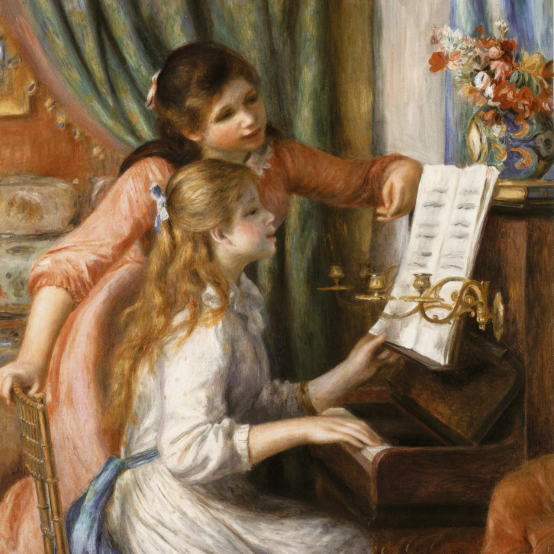
Painted in 1892, Young Girls at the Piano marks another shift in Renoir’s work. This piece was created on commission for the French state to be hung in the Musée du Luxembourg, a museum for the work of living artists. The subject—two young girls from a bourgeois family engrossed in a musical score—is one of quiet intimacy and refined domesticity. Renoir produced multiple versions of this composition, experimenting with subtle changes in touch and color, underscoring its importance to him.
The Bourgeois Interior: A World of Comfort and Culture
The setting is a warm, comfortable bourgeois interior, filled with plush furniture, rich drapery, and the gleaming wood of the piano. This environment speaks to a world of culture, education, and familial harmony. The focus on music and shared artistic pursuit highlights the values of the era’s upper-middle class. Renoir captures the textures of the room—the velvet of the curtain, the polish of the piano, the softness of the girls’ dresses—with a delicate and appreciative touch, creating an atmosphere of serene contentment.
A Study in Concentration and Harmony
The core of the painting is the interaction between the two girls. One sits playing, her focus on the sheet music, while the other leans in, her arm around her companion’s shoulder, following along. Their physical closeness and shared gaze create a powerful feeling of intimacy and connection. Renoir masterfully captures their youthful innocence and the quiet absorption of the moment. The flowing lines of their hair and dresses merge, visually uniting them and reinforcing the theme of harmony—both musical and personal. The composition is soft and flowing, with curving lines that echo the gentle melody one imagines them playing.
Renoir’s Delicate Touch: Brushwork and Warm Palette
In this later period, Renoir’s brushwork became feathery and light, and his color palette is dominated by warm tones—pinks, reds, and creamy whites—that give the scene a rosy, almost ethereal glow. The light appears to emanate from within the room, bathing the girls in a soft, flattering luminescence. This technique differs significantly from the sharp, flickering light of his earlier outdoor scenes. Here, the light is gentle and stable, reflecting the tranquility and security of the domestic sphere. The painting is a testament to Renoir’s ability to adapt his style to suit his subject, capturing not just a visual moment but its underlying emotional tone.

Common Threads: Renoir’s Enduring Artistic Vision
While these three paintings depict vastly different scenes—a bustling public dance, an intimate gathering of friends, and a quiet domestic moment—they are united by the core tenets of Renoir’s artistic philosophy. Across all his work, there is an unwavering focus on the beauty of the human form and the warmth of human relationships. He was, above all, a painter of people, capturing their gestures, expressions, and interactions with unparalleled empathy and skill.
Furthermore, his lifelong fascination with light is the technical thread that binds his oeuvre. Whether it’s the dappled sunlight of Montmartre, the bright riverside glow of Chatou, or the soft interior luminescence of a Parisian apartment, Renoir used light to define form, create atmosphere, and infuse his canvases with life and energy. He saw light not just as an optical phenomenon but as an emotional force, capable of conveying joy, serenity, and vitality. Through his revolutionary use of color and his dedication to capturing the fleeting beauty of his world, Renoir created a body of work that continues to resonate with viewers, reminding us of the profound joy that can be found in the simplest moments of life.
Frequently Asked Questions (FAQ)
- What makes Renoir a key figure in the Impressionist movement?
- Renoir was a founding member of the Impressionist group and a key figure due to his focus on capturing the transient effects of light and atmosphere, his use of vibrant color and visible brushstrokes, and his choice of modern life subjects. Works like Bal du moulin de la Galette perfectly embody the Impressionist goal of capturing a fleeting, sensory moment rather than a detailed, static scene.
- How did Renoir’s style change over his career?
- Renoir’s style evolved significantly. His early work is classic Impressionism, characterized by loose brushwork and a focus on light (e.g., Moulin de la Galette). In the 1880s, after a trip to Italy, he entered his “Ingres period,” incorporating more solid forms and defined outlines, as seen in Luncheon of the Boating Party. His later work, like Young Girls at the Piano, is characterized by a feathery touch and a warm, rosy palette, with a focus on more intimate, often domestic, scenes.
- Why was Renoir’s use of light and shadow considered revolutionary?
- Traditional academic painting dictated that shadows should be painted using black or grey. Renoir, along with other Impressionists, broke this rule by rendering shadows with color, often blues and purples, to reflect how the eye perceives them in natural light. His technique of using patches of color to represent dappled sunlight, as seen on the figures in Bal du moulin de la Galette, was a radical departure that aimed to capture the visual experience of light more accurately.
- Who were the people depicted in “Luncheon of the Boating Party”?
- The figures were all friends and acquaintances of Renoir, which adds a personal dimension to the painting. They included his future wife Aline Charigot, fellow artist Gustave Caillebotte, art collector Charles Ephrussi, and various models, journalists, and actors from his social circle. This transformed the work from a simple genre scene into an intimate group portrait.
- What is the significance of “Young Girls at the Piano” being a state commission?
- The commission from the French state for the Musée du Luxembourg was a significant mark of official recognition for Renoir. It signaled that his art, once considered radical and rejected by the official Salon, had become accepted and celebrated by the art establishment. The choice of a pleasant, harmonious domestic subject was also well-suited for a public institution, showcasing a more classical and less controversial side of his work.