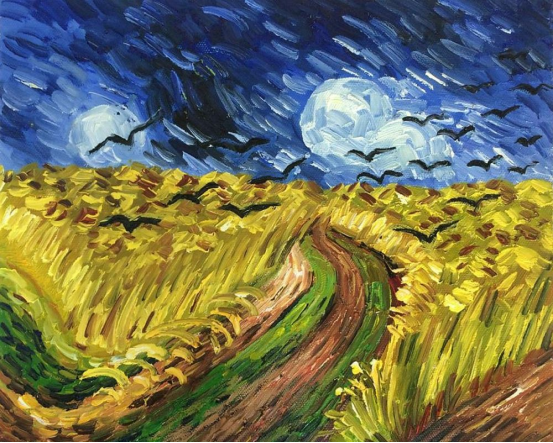
The Genesis of Van Gogh’s Emotional Landscapes
The final years of Vincent van Gogh’s life were characterized by intense psychological turmoil, yet they simultaneously birthed an era of unprecedented creative output. Moving away from the strict observational tenets of early Impressionism, Van Gogh began to project his internal emotional states onto the external world. This transformative period was largely split between two critical locations: the Saint-Paul-de-Mausole asylum in Saint-Rémy-de-Provence, and the rural commune of Auvers-sur-Oise. In these environments, nature ceased to be merely a subject; it became a vivid, pulsating canvas for his existential reflections, spiritual yearnings, and profound melancholia.
To understand the depth of his late masterpieces, one must first examine the environment that cultivated his signature Post-Impressionist style. The aggressive impasto technique, characterized by thick, rhythmic application of paint, served as a physical manifestation of his mental energy. By manipulating color theory and employing exaggerated, swirling forms, Van Gogh created a visual language that communicated far beyond the confines of traditional realism.
The Saint-Rémy Asylum and Spiritual Awakening
Following the infamous ear-mutilation incident in Arles, Van Gogh voluntarily admitted himself to the asylum in Saint-Rémy in May 1889. Confined largely to his room and the hospital gardens, his perspective was literally framed by the iron-barred window of his cell. It was through this restrictive lens that he observed the night sky, transforming his feelings of isolation into a profound spiritual communion with the cosmos. The resulting artwork from this period reflects a man desperately seeking solace and divine connection amidst the terrifying reality of his deteriorating mental health. The night sky, previously a terrifying abyss to many artists, became a source of luminous hope and eternal mystery for Van Gogh.
Auvers-sur-Oise and the Final Days
In May 1890, seeking a closer connection to his brother Theo and under the care of Dr. Paul Gachet, Van Gogh relocated to Auvers-sur-Oise. The landscape here was vastly different from the Mediterranean vibrancy of the South. The sprawling, seemingly infinite wheat fields surrounding the village evoked a complex mixture of freedom and agonizing loneliness. During these final seventy days of his life, his brushwork became increasingly frantic and his compositions more aggressive. The paintings from Auvers are characterized by a raw, unfiltered confrontation with mortality, stripping away the spiritual comfort found in his earlier works to reveal a stark, earthly reality.

Decoding The Starry Night: Silence and Prayer in the Heavens
Created in June 1889, “The Starry Night” stands as a monumental achievement in Western art, encapsulating a moment of profound silence and prayerful contemplation. Unlike many of his works painted en plein air, this masterpiece was constructed from memory and imagination within the walls of his studio at the asylum. The painting is a symphonic orchestration of rolling hills, a sleeping village, and an explosively dynamic sky. It represents Van Gogh’s attempt to reconcile the earthly realm with the infinite, utilizing a visual vocabulary that is both deeply personal and universally resonant.
The emotional core of “The Starry Night” lies in its juxtaposition of tranquility and turbulence. The village below rests in a state of quiet slumber, its geometric, dark forms grounding the composition. Above it, the heavens are alive with ferocious energy, a swirling vortex of celestial bodies that seem to pulse with a divine, almost terrifying power. This dichotomy perfectly mirrors Van Gogh’s internal state: a yearning for peaceful grounding while being swept up in the uncontrollable currents of his own mind.
The Swirling Cosmos and Astronomical Accuracy
The sky in “The Starry Night” is dominated by a massive, wave-like formation that rolls across the canvas. While it appears wildly expressive, modern astronomical research suggests that Van Gogh accurately depicted the position of the moon, the constellation Aries, and the planet Venus (the bright “morning star” near the cypress tree) as they appeared in the pre-dawn sky of June 1889. Furthermore, physicists have noted that the swirling patterns in the sky closely align with the mathematical principles of fluid turbulence, a phenomenon incredibly difficult to capture visually. This suggests that Van Gogh’s heightened emotional state granted him an intuitive understanding of the universe’s hidden kinetic energies.
- Prussian Blue and Ultramarine: Van Gogh utilized multiple shades of blue to create the deep, resonant background of the night sky, applying the paint with varied brushstrokes to simulate the shimmering atmosphere.
- Indian Yellow and Zinc Yellow: The stars and the crescent moon are painted with intense, luminous yellows, creating a stark, vibrating contrast against the cool blues, enhancing the painting’s visual vibration.
- The Halo Effect: By surrounding each celestial body with concentric, broken brushstrokes, he gave the stars a radiant, pulsating quality, turning them into beacons of spiritual light.
The Cypress Tree and the Sleeping Village
Anchoring the left side of the composition is a towering, flame-like cypress tree. In Mediterranean culture, the cypress is traditionally associated with death and cemeteries. However, in Van Gogh’s visual lexicon, it serves as a bridge between the earthly and the divine, its dark branches reaching upward like a silent prayer connecting the sleeping world to the turbulent heavens. The village itself, featuring a steepled church that recalls his native Netherlands rather than French architecture, represents a nostalgic longing for home and the comforting, yet distant, presence of organized religion.

Wheatfield with Crows: The Yellow Wilderness Cries Under Dark Shadows
Painted in July 1890, just weeks before his tragic death, “Wheatfield with Crows” is arguably one of Van Gogh’s most haunting and intensely debated canvases. Unlike the upward-reaching spirituality of “The Starry Night,” this painting forces the viewer’s gaze downward into a claustrophobic, horizontal expanse. The canvas is dominated by an aggressive, almost violent application of paint, capturing a landscape that feels as though it is crying out in despair under the weight of an impending storm. It is a masterpiece of psychological projection, where the natural world becomes a mirror for the artist’s overwhelming sense of isolation and existential dread.
The composition is famously unsettling. The traditional rules of perspective are warped, creating a sense of disorientation. The viewer is positioned at the intersection of three dirt paths, none of which offer a clear destination. The sky, a heavy, oppressive mass of blue-black, bears down upon the vibrant, almost radioactive yellow of the wheat, creating a visual friction that is deeply palpable. This is not a landscape of pastoral peace, but a psychological battlefield.
Chromatic Tension: Yellow Fields Against Blue-Black Skies
The emotional impact of “Wheatfield with Crows” relies heavily on Van Gogh’s mastery of complementary colors. The intense, golden-yellow of the ripe wheat symbolizes life, vitality, and the fertile earth. However, this life force is violently juxtaposed against the brooding, dark blue sky, which threatens to swallow the landscape whole. The contrast is so extreme that the colors seem to physically clash on the canvas. Van Gogh himself wrote of using these colors to express “sadness and extreme loneliness.” The rapid, slashing brushstrokes used to render the wheat give the field a chaotic, restless energy, as if it is being whipped by a fierce, unseen wind.
The Symbolism of the Ominous Crows and Diverging Paths
The elements within the landscape are heavy with symbolic weight, contributing to the painting’s narrative of finality and despair. The flock of crows, rendered with stark, black, V-shaped strokes, rises from the wheat and flies toward the foreground, seemingly converging on the viewer. Crows are historically omens of death, doom, and scavenging, and their chaotic flight pattern adds a sense of panic and inevitability to the scene.
- The Central Path: The dirt road in the center of the composition abruptly ends in the middle of the field, leading nowhere. This is widely interpreted as a metaphor for Van Gogh’s own life journey, which he felt had reached a sudden, insurmountable dead end.
- The Flanking Paths: The paths on the left and right run out of the frame, offering no clear direction or escape, further emphasizing the feeling of being trapped in the wilderness.
- The Green Margins: The vibrant green edges of the paths provide a fleeting glimpse of life and growth, but they are ultimately overpowered by the dominant clash of the yellow wheat and the dark sky.
The Enduring Legacy of Van Gogh’s Dual Masterpieces
When viewed together, “The Starry Night” and “Wheatfield with Crows” offer a profound summary of Vincent van Gogh’s artistic and psychological journey. They represent the two poles of his existence: the desperate search for spiritual salvation in the cosmos, and the agonizing confrontation with his earthly suffering. His ability to synthesize profound emotional truths with revolutionary painting techniques laid the foundational groundwork for the entire trajectory of modern art.
The influence of these works cannot be overstated. By prioritizing emotional expression over realistic depiction, Van Gogh single-handedly paved the way for Expressionism, Fauvism, and abstract art. Artists like Edvard Munch and the German Expressionists drew direct inspiration from his use of distorted forms and arbitrary colors to convey psychological states. Today, these paintings are not merely viewed as historical artifacts, but as living, breathing testaments to the resilience and vulnerability of the human spirit.
Impact on Post-Impressionism and Expressionism
Van Gogh’s departure from the optical truths of Impressionism created a paradigm shift. Where Impressionists sought to capture the fleeting effects of light, Van Gogh sought to capture the enduring weight of emotion. His technique of applying thick layers of paint (impasto) gave his canvases a sculptural, three-dimensional quality, demanding that the viewer engage with the physical reality of the paint itself. This tactile approach to art-making deeply influenced the Expressionist movement of the early 20th century, which adopted his belief that art should come from within.
Modern Interpretations and Psychological Insights
Modern art historians and psychologists continue to mine these two paintings for insights into the relationship between creativity and mental illness. While it is a romanticized myth that Van Gogh’s genius was solely a product of his madness, it is undeniable that his unique neurological and psychological makeup allowed him to perceive the world with an intensity that few others possess. The structural complexities of his compositions prove that even in his darkest moments, he maintained an incredible degree of artistic control and intellectual rigor.
| Feature | The Starry Night (1889) | Wheatfield with Crows (1890) |
|---|---|---|
| Primary Emotion | Spiritual yearning, awe, quiet contemplation | Existential dread, isolation, chaotic despair |
| Color Palette | Cool blues, luminous yellows, tranquil greens | Aggressive yellows, heavy blue-blacks, stark reds |
| Compositional Flow | Upward, swirling, circular and ascending | Horizontal, oppressive, converging and inescapable |
| Symbolic Motif | The Cypress Tree (Bridge to heaven) | The Crows (Omens of finality and death) |
Frequently Asked Questions (FAQ)
- Was “Wheatfield with Crows” truly Vincent van Gogh’s final painting?
- Despite a popular myth perpetuated by films and literature, “Wheatfield with Crows” was likely not his very last painting. Art historians believe he painted several other works, such as “Tree Roots” and “Daubigny’s Garden,” in the days immediately preceding his death. However, “Wheatfield with Crows” remains his definitive psychological final statement, perfectly encapsulating his feelings of isolation and impending doom.
- Why did Van Gogh paint the sky in “The Starry Night” with swirling patterns?
- The swirling patterns represent a combination of Van Gogh’s vivid imagination, his emotional turbulence, and his keen observation of the natural world. Some researchers believe the swirls were inspired by astronomical drawings of the Whirlpool Galaxy (M51) made by Lord Rosse, which were circulated in scientific journals of the era. The technique also served to visualize the unseen spiritual energy that Van Gogh felt permeated the universe.
- What do the crows in the wheatfield symbolize?
- In Western art and literature, crows are traditionally associated with death, bad omens, and the afterlife. In the context of this painting, they are widely interpreted as manifestations of Van Gogh’s dark, intrusive thoughts and his awareness of his approaching mortality. Their chaotic flight pattern towards the viewer creates a sense of claustrophobia and inescapable fate.
- Where are these two masterpieces currently located?
- “The Starry Night” is a permanent highlight of the collection at the Museum of Modern Art (MoMA) in New York City. “Wheatfield with Crows” is prominently displayed at the Van Gogh Museum in Amsterdam, Netherlands, alongside many of his other late-period works.
- How did Van Gogh’s mental health influence his use of color?
- As his mental health fluctuated, Van Gogh increasingly used color arbitrarily to express emotion rather than to describe reality. During periods of intense distress, he often relied on stark, vibrating contrasts of complementary colors—such as the yellow and dark blue in “Wheatfield with Crows”—to create visual tension and communicate profound psychological discomfort and loneliness.