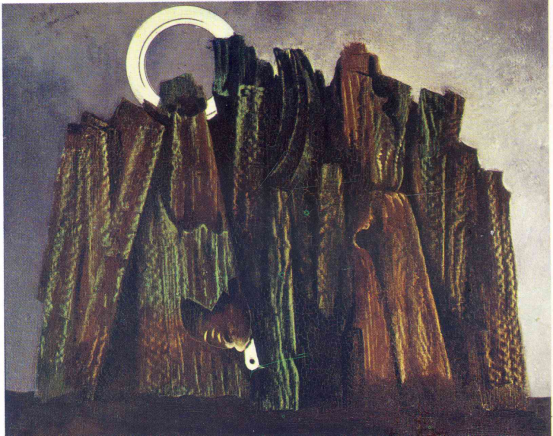
Ernst’s Storm in the Forest: Trees Transformed into Human Shadows
Max Ernst’s fascination with the forest represents a pivotal exploration of the boundary between the organic world and the human psyche. In his series depicting the Storm in the Forest, Ernst abandons traditional landscape painting, opting instead for a visceral, nightmarish interpretation of nature. The trees are not mere flora; they are distorted, towering entities that mirror the human condition, often appearing as spectral figures or shadows trapped in a perpetual state of flux.
The Anthropomorphic Forest
In these compositions, Ernst utilizes techniques like frottage to create textures that evoke the raw, unpredictable chaos of a storm. By rubbing graphite over textured surfaces, he allowed the subconscious to dictate the forms of the trees, resulting in jagged, limb-like branches that suggest human agony or reaching hands.
- Psychological Projection: The forest acts as a mirror for the artist’s internal fears and the collective anxiety of the post-war era.
- Morphological Shifts: The trees frequently blur the lines between wood and flesh, emphasizing the fragility of life.

Relics of Civilization on an Alien Planet: An Analysis of Max Ernst’s The Whole City
In The Whole City, Ernst pivots from the organic wild to the architectural ruin. This work presents a landscape that feels inherently extraterrestrial, yet undeniably rooted in the debris of human history. The “city” depicted is a graveyard of structures, suggesting a civilization that has collapsed under its own weight, left to wither on a barren, alien terrain.
The Aesthetics of Ruination
Ernst employs a geological approach to his cityscapes, treating buildings as if they were fossils embedded in stone. The composition lacks a clear horizon, creating a claustrophobic sense of entrapment. This serves as a critique of industrial progress and the inevitable decay that follows the height of human technological ambition.
| Element | Symbolic Meaning |
|---|---|
| Geometric Monoliths | Stagnation and the loss of human connection. |
| Barren Landscapes | The void left by failed ideologies. |

Prophecy of the Age of Monsters: Max Ernst’s Celebes the Elephant
Perhaps his most iconic work, Celebes (or The Elephant Celebes) stands as a monumental prophecy of the 20th century. The central figure—a mechanical, elephant-like creature—is a jarring synthesis of industrial machinery and biological form. With its boiler-like body and predatory stance, it serves as a harbinger of the “Age of Monsters,” reflecting the dehumanization of society through the rise of technology and mechanized warfare.
Deconstructing the Mechanical Beast
The juxtaposition of the elephant’s massive, immobile form against the delicate, floating elements in the background highlights the absurdity of the surrealist vision. Ernst forces the viewer to confront the “monstrous” nature of reality, where the lines between the living and the constructed have been irrevocably erased.
- Technological Fear: The boiler body represents the industrial revolution’s encroachment on the natural world.
- Collage Logic: By combining disparate imagery, Ernst constructs a dream-logic that bypasses rational interpretation.
Frequently Asked Questions (FAQ)
- What is the significance of the “forest” in Max Ernst’s art?
- The forest serves as a psychological landscape for Ernst, representing the intersection of the natural world and the subconscious mind. It often reflects themes of growth, decay, and transformation.
- How did Max Ernst use the frottage technique?
- Frottage involves taking rubbings from textured surfaces like floorboards or leaves. Ernst used this to bypass conscious control, allowing the resulting patterns to suggest shapes that he then developed into full surrealist compositions.
- What does the elephant in ‘Celebes’ symbolize?
- The elephant represents a fusion of the biological and the mechanical. It is a symbol of the impending “Age of Monsters,” reflecting the anxiety regarding industrial progress and the loss of human identity in a mechanized society.
- Why are Ernst’s cityscapes described as ‘alien’?
- They are described as alien because they reject conventional perspective and architectural logic. They depict crumbling, fossilized, or otherworldly structures that suggest the end of civilization rather than its peak.