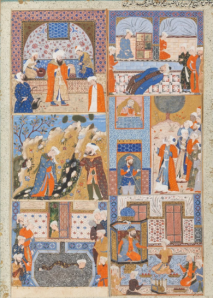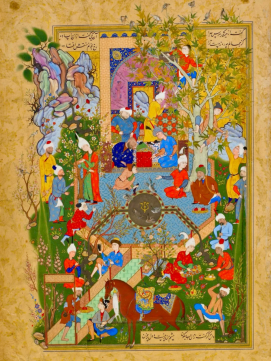
The image of “garden” often appears in Persian miniature paintings. Driven by curiosity, I looked for the artistic aesthetics and cultural implications it carries.
Origin and development
Persian miniature painting originated from the border patterns of the Quran. In the early days, it was influenced by Greek and Syrian styles, with colorful and decorative features. In the 13th century, the Mongols invaded and Chinese painting techniques were incorporated, which made miniature painting begin to focus on lines and artistic conception.
Painting Techniques
Persian miniatures are usually painted on paper or parchment pages, mostly with mineral pigments made of malachite, lapis lazuli, silver, etc. The colors are bright and saturated, not easy to fade, and very decorative. In Persian miniatures, people are often the core elements of the painting.
Miniaturists depict the world and arrange compositions through the eyes of Allah. Therefore, Persian miniatures are often depicted from a bird’s-eye view. Objects are similar in size regardless of their distance, and the distance relationship is indicated by the relationship between the lower part being larger and the upper part being smaller. This is different from both traditional European paintings and Chinese paintings.
Miniature paintings never depict darkness or shadows, and the figures and scenery in the night are always as beautiful as those in the daytime. In miniature paintings, you can see blue horses, green skies or purple hills. The whole picture is colorful, presenting a fantasy and sublime beauty.
Subject matter
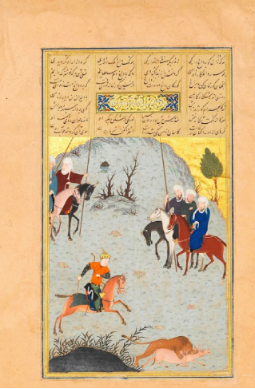
Mainly mythological stories, folk tales and court life, etc., with bright colors and lively painting styles, pursuing decorative effects. The size of miniature paintings does not exceed the size of a page, and the fine depiction of details is one of its major features. Persian miniature paintings pursue flat visual enjoyment, using Arabic geometry and plant patterns, which are highly decorative and also create a “spiritual enlightenment atmosphere.”
Appreciation of works
In order to more intuitively feel the charm of Persian miniature paintings, let us appreciate several classic works.
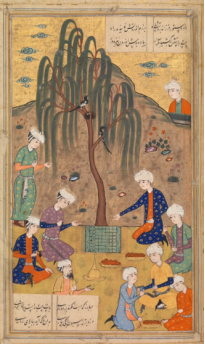
Miniature painting is similar to the bird’s-eye view from a 45-degree angle looking down from a high altitude. From God’s perspective, everything in the world is seen. Without the night, people and objects in the distance are no different in size from those nearby. People and objects behind the mountain are not blocked by the mountain, and houses and buildings cannot block the eyes of “God”. In miniature painting, houses and buildings are like being cut open by a knife, and the activities of the people inside are clearly visible. It can produce a three-dimensional visual effect, which can weaken or eliminate the interference of other elements in the painting and focus on the main elements in the painting.