As a long-term researcher of Mesoamerican civilization, I have recently studied Mayan sculpture art again. Speaking of Mayan civilization, I believe everyone is familiar with it. Mayan civilization was once one of the most brilliant and mysterious civilizations on earth.
The Maya lived from about 1200 BC to about 250 BC in Central America and around Mexico, in what is now Guatemala, El Salvador, Mexico, Belize and Honduras. The ancient Maya civilization flourished around 2600 BC. One of the most complex civilizations in history, the ancient Maya civilization had a population of about 19 million at its peak. The Maya invented a unique writing system in 700 BC and used it to create a solar calendar on stone. They were gifted astronomers who were able to calculate dates by studying the movement of the sky. But then the Maya civilization suddenly and mysteriously disappeared, and it remains an unsolved mystery to this day.
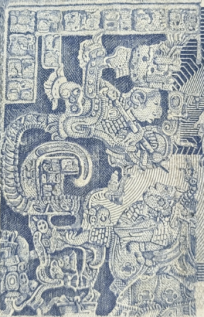
“Relief of the Temple of Achillea”
Noble women played an important role in Mayan society, and some extant works of art record their upper-class status.
The polychrome relief frieze of Temple 23 of Aceh shows a noblewoman as a central figure in Mayan rituals. She was solemnly dressed in an elaborate brocade garment, tiara and jewellery. The king performed a bloodletting ritual by piercing his tongue with a barbed cord, which, according to the inscription next to it, was to celebrate the birth of a son by another of his wives, and also to celebrate the alignment of Saturn and Jupiter. The ceremony took place in a dark room or at night, as indicated by the burning torch held by the king’s shield-like jaguar for illumination.
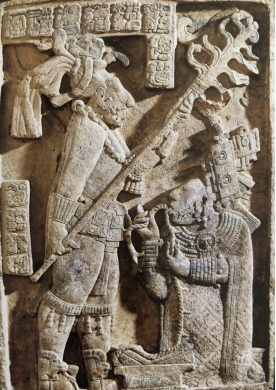
Mysterious Mayan reliefs and murals
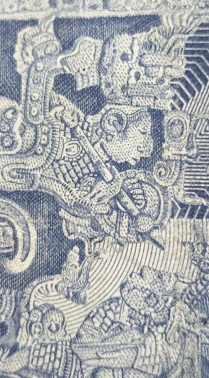
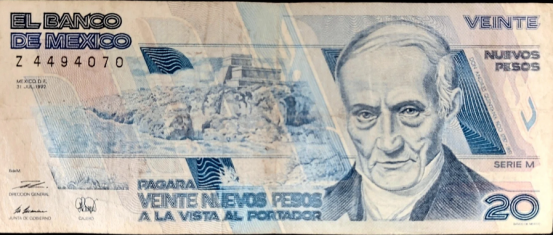
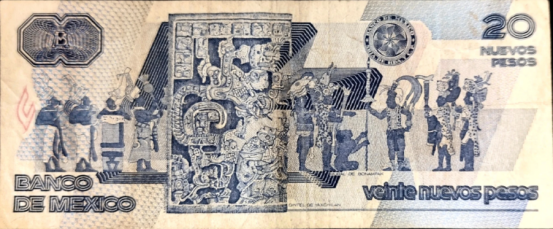
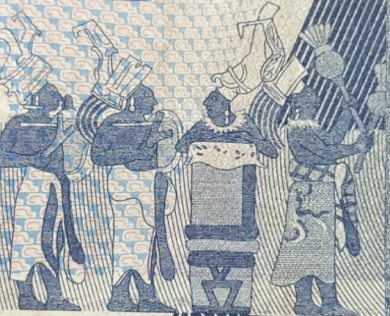
This is a Mexican 20-peso note from the 1980s, which was revalued from 20,000 pesos during the previous period of high inflation. The entire note is full of Mayan style. The figure on the front is the Mexican politician Quintana Ro. The state of Quintana Ro on the Yucatan Peninsula, which is full of ancient Mayan cultural relics, is named after him. There is also a Mayan warrior temple next to it. On the back is the most complete ancient Mayan mural – the Bolan Park mural, and in the middle is a relief of the ruins. The front of the note combines the relief and the mural, making the picture structure more vivid and rich.
If you are interested in Mayan carving art, I recommend you to follow the online exhibition of the National Museum of Anthropology in Mexico. In addition, if you know other interesting Mayan carving details or research results, please share them in the comments section!